|
|
|
|
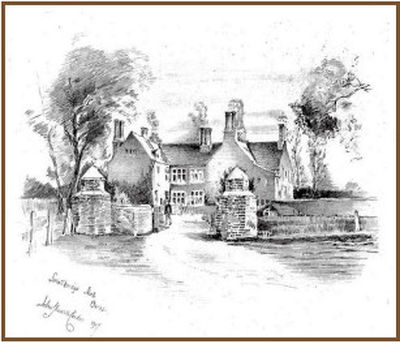
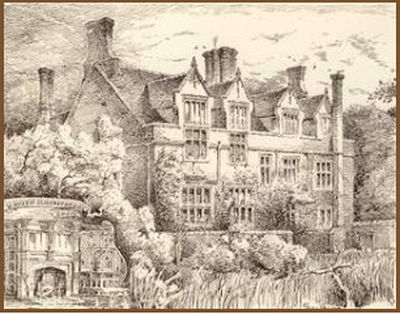
Paintings by CORDER,
John Shewell 1856 - 1922
Dated 1917 (The inset in the right image portrays Elizabethan
fireplace on one of the rooms)
|
|
|
|
|
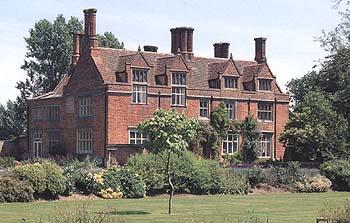
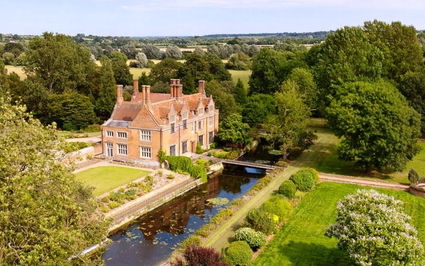
Aerial
View
|
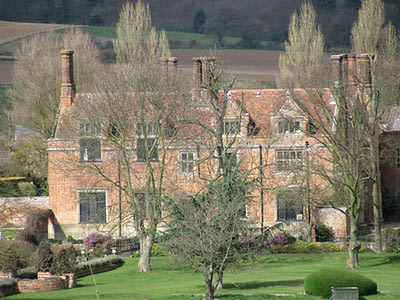
View
taken from Lodge Hills
|
|
|
|
|
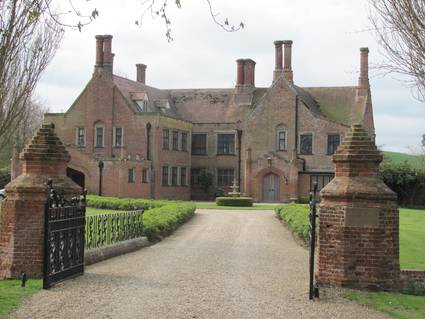
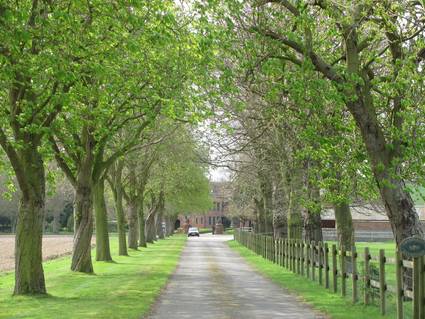
Entrance
Drive
|
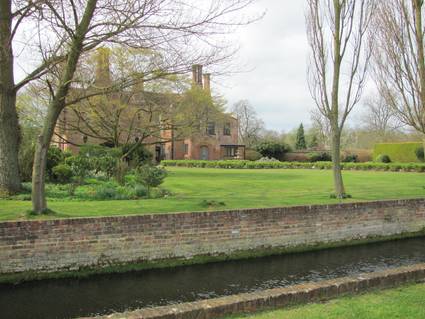
View
looking over Moat
|
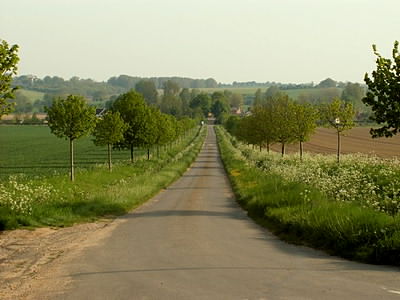 Entrance to Smallbridge viewed from
the Nayland Rd
Entrance to Smallbridge viewed from
the Nayland Rd |
Main entrance gates at the end of the drive |
Background History to Smallbridge Hall.
Smallbridge Hall, on the parish
boundary, part of the moat and the house are in Wissington (Wiston) parish.
Mill at Smalebridge confirmed to monks of Stoke-by-Clare by Richard, Earl
of Clare 1152-73;
Ref:- Heritage Gateway
1235-36:- William de Smalebrege
occurs 1235-6.
Ref:- Heritage Gateway
1310-11:- Michael de Ponyngg and
Margaret his wife (i. e. Sir Michael de Poynings of Poynings & Crawley,
Sussex, and Margaret de Aguillon) held the manor of Smalebregg
Ref:- Heritage Gateway
1362:- Michael de Poynyges granted
manor of Bures Tany and the Chapel of St Stephen to William Baud, Knight
Ref:- Heritage Gateway
1362:-
Joan Buers, widow of Sir Robert de Bures married Sir Richard Waldegrave.
Moved into Smallbridge 1383
Joan carried over the Manors of Silvester and Nether Hall on her marriage.
(Ref:- Historic England)
1368:- William Bawde of Smallbridge
was seized of the manors of Smallbridge and Tanyes 1368-9. He released
his right to feofees 1375 . He died childless 1375
It then passed to Richard Waldegrave
Ref:- Heritage Gateway
In 1383/4 May
10,
Richardus and Joan Waldegrave moved into Smallbridge
Richard Waldegrave was granted, by Richard II, (In year 7 of his reign)
a Royal licence to crenellate Seinte Marie Bures (Smallbridge Hall, Bures
St Mary)
Licence for Richard Waldegrave, knight, to crenellate his manor of Smalbrigg
in the town of Seinte Marie Bures or a certain plot within the said town
Ref: A licence to crenellate was supposedly a grant that gave permission
for a building to be fortified.
13th cent. Granted to Sir Michael
de Pynings by marriage (appears as Division of main manor)
(Ref Babergh DC)
14th cent. William Brand owns (linked
to Polstead, Edwardstone, Gt Cornard and Boxford)
(Ref Babergh DC)
Ref (a)
Having lived at Smallbridge since 1375,
the Waldegrave family sold the debt-encumbered estate in 1702, and while
it remained a gentleman's residence until 1750, by 1800 the Hall was occupied
by a tenant farmer.
(Ref Leigh Alston)
Ref (b)
In 1385 Overhall and Netherhall were held by Sir Richard Waldegrave through
his wife's inheritance, and were managed together with the manors of Smallbridge................................
(Ref Leigh Alston)
Ref (c)
James Butler, Earl of Ormond, a staunch
Lancastrian, was executed in 1461 after the Battle of Mortimer's Cross,
and the two manors of Nether Hall & Over Hall passed for a short time
to Anne Woodville, the sister of Edward IVth's Queen, before being granted
to the Waldegraves of Smallbridge.
(Ref Leigh Alston)
For
a more detailed list of the Waldegraves who lived in Smallbridge
**1523: On Cardinal Wolsey`s downfall
Church Manor went with the church, through a number of owners to the Mannocks
and eventually became part of the Elizabethan Sir William Waldegrave's
estate. He transformed the gentle slopes of Wormingford into a deer park
and connected it to his grand red brick house by a bridge across the Stour.
From that time the name Small Brigg gradually changed to Smallbridge
House.
Note:- Cannot ascertain who owned the Deer Park, The
"Victoria County History of Essex" suggests it could have been
owned by the Waldegraves at Smallbridge. It could of course be part of
Wormingford Hall or Church Manor
**Note:-
Victoria County History of Essex" gives a date of 1578 when
the Waldegraves purchased Church Hall, but this seems far to late
Several late sixteenth century maps of
Suffolk illustrate a park at Smallbridge, but do not make its exact location
clear. The problem is compounded by the fact that Wormingford Park, which
also belonged to the Waldegraves, was sometimes referred to as Smallbridge
Park. A 1528 survey of Church Hall manor in Wormingford describes the
land which borders Wormingford churchyard to the east as "the parke
of Sir Willyam Walgrave knight called Smallbridge Parke". The
lodge of this park stood upon Lodge Hill until its demolition in the
Eighteenth Century. (Ref:- Leigh Alston)
1554:- William Waldegrave (Later
Sir William) inherited the Manors of Wormingford and Bures from Sir Richard
Waldegrave
1555 - 1561: Smallbridge Hall completely
re-built by the Waldegraves. Sir William (1507 -1554) demolished the old
manor house and built an impressive new Hall with 44 hearths.
1561 Sir William entertained his
Queen, Elizabeth I, for two days in August.
See additional page
Sir Edward Waldegrave of Smallbridge
was an ardent supporter of Queen Mary and the Old Faith. In consequence
he was imprisoned (and died 1561)in the Tower by Queen Elizabeth and his
manors of Wormingford and Bures given to his nephew William Waldegrave,
Anthony's son.
William was an energetic and ambitious man he converted the rolling slopes
of Wormingford into a deer park and rebuilt Smallbridge Hall in the style
of Hampton Court. It was a fine red-brick mansion boasting forty-four
hearths. Queen Elizabeth visited it on two occasions and was lavishly
entertained by Sir William.
Noble houses where Queen Elizabeth stayed were permitted to display her
Cypher on a Tudor Rose. This device is in Church Hall and it is thought
it was removed from Smallbridge Hall.
Queen Elizabeth partook of meat and
ale in Church Hall; and was so pleased she wrote her initials on a window
pane with a diamond ring.
There may be some truth in the tale. Sir William's son (another Sir William)
lived at Church Hall with his second wife, the Lady Jemmimah. She was
the neice of Sir Francis Bacon, the Lord Chancellor, and was at one time
one of the Queen's Ladies. Therefore it is possible the Queen paid a social
call on Lady Jemmimah and accorded the honour of her Cypher to
Church Hall out of the esteem she had for Sir Francis and his family.
No matter how much money Sir William, the Elder, spent on his Queen he
never quite escaped the taint of his uncle's treason.
Lady Jemmimah's husband died eight months after his father in 1610. She
retired to the Dower House of Wormingford Hall but continued in control
of the Church Manor and the Parsonage House
1578: The Queen second visit to
Suffolk, See additional page
Various books mention a second visit, but there is no factual evidence
to support this statement
ie:- Wormingford, an English Village" by Winifred
Beaumont and Ann Taylor ,
1588: Sir William spent a fortune
on entertaining his Queen and another on raising and equipping 500 men
to resist the Spanish Armada "all choice men and singularly well
furnished".
Nichols, a member of the Royal household, travelled with the Queen and
kept a journal of her journeys. He described in detail the grand houses
visited and the wonderful entertainment's they provided but only made
a sparse report on her visits to Smallbridge, over a sour footnote:
Sir Edward Waldegrave was eventually held in the Tower of London for Treason
1600: The house is known to have
had a chapel dedicated to St.Anne and it also had a gatehouse.
17th cent. John Currant/Currance
owns
(Ref Babergh DC)
1650: The Lodge indicated on a local
map of the area
1643 William Dowsing a parliamentary
envoy was sent upon a tour of Suffolk to purge the churches of all images
and popish symbols. He smashed his way through the county and came to
Smallbridge House where he was graciously received by the Lady Elizabeth.
But his plans to purge their private chapel were foiled by a simple ploy.
The chapel door was locked and the key lost.
1957 A Tudor key was found on the
river bank in deer meadow, opposite Smallbridge, which could have been
thrown or lost from the bridge in a moment of panic.
1705:The
property stayed in the Waldegrave family until it was sold.
The Waldegrave family name ceased to exist at Smallbridge.
Having lived at Smallbridge since 1375,
the Waldegrave family finally sold the estate in 1705, and while it remained
as a gentleman's residence until at least 1750, by 1800 the Hall was occupied
by a tenant farmer.
Encumbered by debt, and with both house and farm buildings in a dilapidated
condition, the 547-acre estate was again sold (for only the second time
since 1375) in 1849.
On the 27th of July that year George Wythes Esquire of Reigate, Surrey,
paid £11,350 for it at auction in the city of London.
Wythes continued to reside in Reigate, and the Hall remained a tenant
farmhouse until its renovation earlier this century. A report drawn up
for the new owner in February 1850 by William Downes of Dedham recommends
the repair of the existing mansion, and 'to pull down the old and to erect
an entire new set of Agricultural Buildings upon an improved arrangement
as per plan furnished to Mr Jackson.
To repair the present set would be an injudicious waste of money whilst
the materials of them being extensive, sound and excellent for reconverting,
would go far towards those required for the erecting the new ones.' (Suffolk
Record Office, Bury St. Edmunds, Acc. 324).
Downes, or perhaps his father, had been commissioned to survey and map
the parish of Bures Hamlet in 1819, and was familiar with the area; although
the plan to which he refers has not survived, there can be little doubt
that he was personally responsible for the design of the new buildings.
A map of the Smallbridge estate published
prior to its sale in 1849 clearly shows the range of farm buildings lying
to the east of the modern entrance drive on a site which is now a rubble-strewn
field.
On the strength of Downes' recommendation, presumably in 1850 or shortly
thereafter, the 16th century buildings were demolished
and an 'improved arrangement' laid out in what had been a walled paddock
on the opposite side of the road.
The fact that a contractors agent' from Cumberland was in residence at
the Hall in 1851 may be relevant to the date of construction. Much of
this model farm survives largely untouched. The nature of the re-used
oak
timber and brick with which the inner walls, including those of the mill,
are partly constructed suggests that the barns and
outbuildings that Downes demolished were contemporary with Smallbridge
Hall itself.
18th cent:- The Lodge was demolished
during the 1700`s
(ref Leigh Alston)
18th cent. Hanbury family from Essex owns
(Ref Babergh DC)
1849. On the 27th of July that year
George Wythes Esquire of Reigate, Surrey, paid £11,350 for it at
auction in the city of London.
1893 to 1958, Imrie family moved
down from Scotland to Smallbridge and Farm
circa 1930
The Imrie family vacated the Hall and moved into the Farmhouse
Lady Phyllis MacRae was daughter of Alice Frances Theodora Wythes,
who was the grandaughter of George Wythes the railway engineer who built
the farm buildings. Alice married Frederick William Fane Hervey the 4th
Marquis of Bristol. Her fortune was used to "save" Ickworth
House.
Lady Phyllis lived at Smallbridge from around circa 1929/30 to 1947 and
brought up her family there.
1932 The house was again rebuilt
and further restored by Lady Phylis Macrae, daughter of the Marchioness
of Bristol.
1947 Lady Phyllis moved back to Ickworth
- her father died in 1951 and her mother in 1957 -
1947 Smallbridge was leased for
7 years to a Mr J Lowe.
1954 It was subsequently leased to Mrs Phyllis Newton and became
a Girls School.
1958 The Imrie family vacated Smallbridge Farm
The Hall was sold by the Trustees of the George Wythes Estate and the
subject of a the lease to Mrs Newton, who subsequently purchased it.
1905 - Mrs F Hervey owner (linked to
Ickworth)
1955- 1972 Girls School
1958 - Advert appears in the EADT for the Sale of the Estate. Sale by
auction by Rutter`s at Colchester
1972 - 1977 Michael Lucas
1977 - 2000 Gregory Moore ( Pont
Data)
2000- Company House listed Nigel Albon, Company Director NA Carriage Company,
wife Kankamol Albon as Company secretary
2004 -Kankamol Albon
took over the property and Company to sell luxury cars
2012 - HMRC claimed property for tax evasion
After the Albons vacated the property and after years of being abandoned,
the roof failed and water poured into the building causing a monumental
amount of damage to the fabric and woodwork
2013 - Mike and Heather Hargrove - current owners
Details on
the Lodge.
|
|
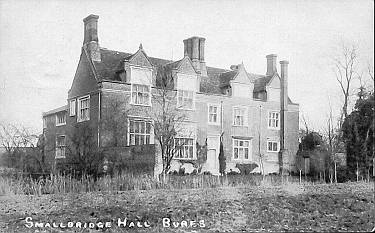
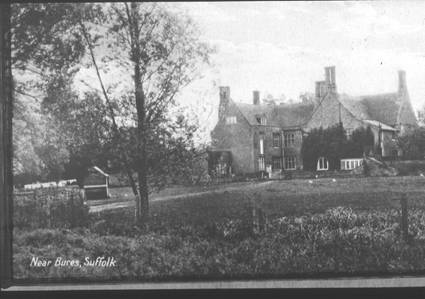
Smallbridge Hall circa 1905 |
|
|
Date unknown |
|
|
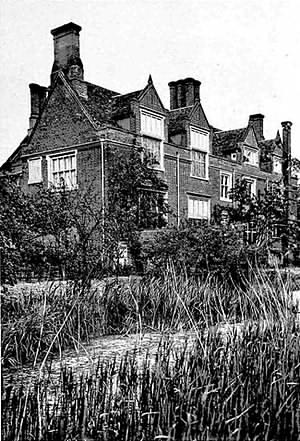
Moat circa 1920 |
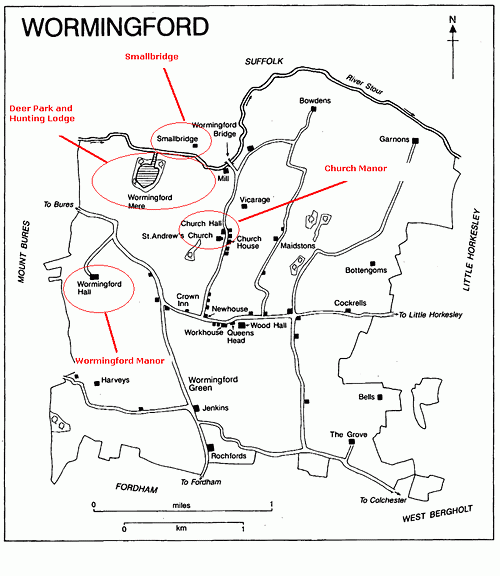
It would appear that the Waldegraves not only owned "Smallbridge"
but the adjoining property of "Wormingford
Hall" and Church Hall from 1383
until 1702.
1702 would have been the time the Waldegraves vacated Smallbridge.
Map showing
Smallbridge and Wormingford Hall
During a 1961 excavation on Sandy Hill,
Wormingford it revealed a Tudor Brick-Kiln.
The bricks were very similar to those used at Layer Marney and Smallbridge
Hall **
During the second world war, Smallbridge
was briefly used as a home for evacuees from London.
NOTE:- Smallbridge
Hall is private property and has no public access. However it can
be seen from the lower road to Wormingford, with a public footpath running
alongside the perimeter wall.
References:- Extracts
from "The Wormingford Story" by Winifred Beaumont: and "Wormingford,
an English Village" by Winifred Beaumont and Ann Taylor ,
Victoriana County History of Essex
Colchester Archaeological Group at
http://caguk.net/
English Heritage
Heritage Gateway
Leigh Alston
Research Alan Beales 01/05/10
Updated 10/05/10
updated 16/04/2015
updated 31/07/2021
updated 21/08/2021 Imrie update
|