Bures-online.co.uk
Serving the communities of Bures St Mary and Bures Hamlet

The Great Fire at Little Ropers Farm


Little Ropers Farm is located on the Bures to Assington road, dating back to approximately 1694.
During the early years it was owned by Trinity Hall College, Cambridge which were substantial land owners in East Anglia.
Mr W Taylor was the Tenant Farmer, he didn't live on site but farmed at Wells Hall Road in Gt. Cornard
The 1841 census indicates the following incumbents:-

John Blandon age 50 Servant
Sarah Blandon age 40 Servant
John East age 14 Servant
Jonathan Knights age 70 Labourer
Mary Knights age 62

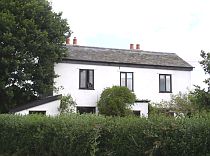
The Farm House we see today(right pic), is not in it`s original position, having moved some 160 years ago.
On the 13th April 1845 a great fire consumed the original timber framed farmhouse and it was completely demolished.
farm

The following day in a letter to Trinity College, the Tenant Farmer Mr William Taylor wrote:-

Dear Sirs,
I am very sorry to inform you that the Little Ropers Farm buildings and house were entirely burned to the ground last night about 9.0 clock and there is little or nothing left but it was the act of incendiaries. We have taken up three men on strong suspicion who have this day been examined and remanded for a week.
There is scarcely any timber belonging to the building saved, it being all on fire in an instant and it was with very great difficulty the inmates of the house were saved. Had it been half an hour later I have no doubt they would have been burned in their beds. I am sorry to say I have lost 3 horses, 3 Cobs 3 sows, 7 Pigs, Wagons, Tumbrel's, 26 Combs of barley, 7 sacks of Tares and various other things which I cannot at present recollect.
And although insured I must be a considerable loser. Perhaps you would like to send someone to look over the ruins as there will be nothing moved until I hear from you. If you wish it, I will come presently to Cambridge and give you all the information I can but I hope I shall hear from you by return of post.
I am yours sincerely,
William Taylor

The 1841 Census records indicate that William Taylor would have been 82 when he wrote this letter. No mean feat at that age to journey to Cambridge, considering it would be on horseback and possibly a days journey each way.

It was subsequently reported in the local newspaper:-

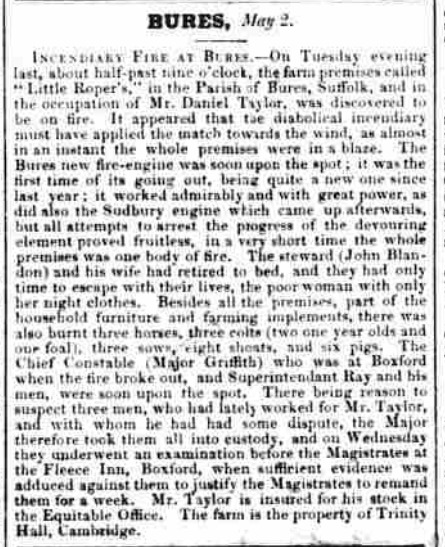
Article in The Bury and Norwich Post and East Anglian newspaper Wednesday May 7th 1845


On Tuesday evening, about 9 o'clock, a fire broke out at a farm called Roper's, in Bures St Mary, held off-hand by Mr W Taylor, sen. of Cornard.

It was first discovered by Mr Phillips, who resides about a quarter of a mile from the farm, and about the same time a boy on the premises was awakened by the cry of the terrified horses, who were then surrounded by the flames.
It was with the greatest difficulty that the bailiff and his wife escaped, so rapidly did the fire extend: and 3 horses, 3 colts, 3 sows, 8 goats, and seven pigs, with all the fowls perished: the dwelling house, 2 barns, stables and other buildings, with wagons, tumbrel's, and other implements, 26 combs of barley, 7 sacks of tares and 2 tons of hay, being all destroyed.
Mr Taylor was insured in the Farmer's Office: the farm belongs to Trinity Hall, Cambridge. Major Griffith, the Chief Constable, was soon on the spot, and 3 men who had been discharged by Mr Taylor, on suspicion of dishonesty, were apprehended, and examined on Wednesday, on suspicion of being the incendiaries

The Mr Phillips who discovered the fire, resided at Gt. Ropers. He was listed as Samson Phillips age 20, in the 1841 census.

Notes taken from Bury Gaol Book. Ref. no. Q/AGR Vol. II


Entries for the 3 men arrested on night of 29th April 1845 on suspicion of setting fire to Little Roper's Farm.

John Cardy - labourer. Age 30. Can neither read nor write.
Father Wm Cardy.
Discharged on examination.
Previous convictions: 1839. Served 6 months.

James Cardy Age: 24. Height 5ft 7". Deaf.
Father James Cardy.
Can read imperfectly.
Also discharged.

George Cardy. Aged 21
Father Wm Cardy.
Charged with the above and also stealing a sack at Bures.
To attend Quarter Sessions at Bury on July 8th 1845.


Notes from Quarter sessions: p. 296. Bury Trinity Sessions 1845.
George Cardy. Acquitted of larceny. To be discharged. The sack was the property of Mr W Taylor of Bures.

Report in The Bury and Norwich Post of Quarter sessions for July simply states that George Cardy was acquitted.


The 1841 Census revealed the Cardy family lived in cottages at Marshalls Green, just along the main road towards Bures. This area is now known as Bures Green, The collection of farm labourers cottages situated there, have long since been demolished.


Coincidentally this outbreak of arson occurred during the period of the "Corn Laws".

The Corn Law of 1815 were introduced to prevent the import of wheat unless the price of British grain rose to £4 a quarter (2.91 hl/8 bushels). To a degree, the law was a success. It did help to protect British farming from foreign competition and to stabilize prices. As they were receiving a high price, farmers were able to continue to introduce improvements. However, the Corn Law pushed the price of bread too high, causing distress to the poor. Business interests argued that, by driving up prices, they also forced up wages and put British industry at a disadvantage in world markets. It was also argued that the Corn Laws allowed British farming to stay inefficient, and actually held back improvement. In 1838 the Anti-Corn Law League was formed to campaign for the repeal of the laws.
In 1846 they were eventually abolished in the face of militant agitation by the Anti-Corn-Law-League

The Cardy`s were acquitted and legally not held responsible. It is not known whether this act of arson was the result of these three disgruntled employees who had previously been sacked, or the militant action of persons unknown as a result of the Corn Laws ?
During the Corn Law period, damage to farm property was commonplace as workers vented their anger against land owners.

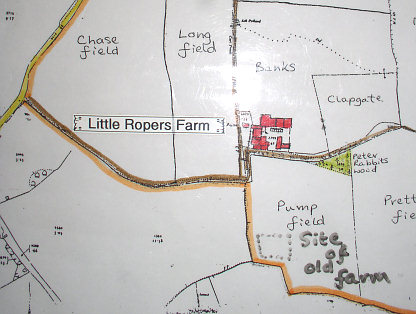
By November 1845 the farmhouse had been rebuilt on the site we see today. map

Letter to the College outlining the rebuilding plans:-

Trinity College, Cambridge.
From the foregoing statement it will appear that there are materials of little value saved from the fire except the old bricks which may be worked upon in the foundations of the new building to be erected.
And those I recommend being done in a substantial manner in conformity with the plan I have prepared to accompany this report.
The site of the buildings is well situated for the occupation of the Bures land and I do not see by removing the site upon a part of the Assington lands in trust that any real benefit will arise, as the lands of other properties intersect the property.
There is a barn now standing on the Assington property and if a small yard at the back of it was enclosed by a stone wall and open cattle shed it would afford every accommodation that can be required for the occupation, when the proposed homestead is reinstated.
There is a fair supply of timber upon the estate particularly on the Assington lands and there is a cottage divided into tenements standing on that part of the property in addition to the barn already deserted.
The builder who has furnished me with the plan, and estimated costs of the erection of the new homestead has I believe been employed on a former occasion by the College and would be happy to undertake their business.

John Isaacson
Surveyor.


It was obviously built in some haste, which was not of the highest quality.
This extract from the Surveyor confirms:

Trinity College, Cambridge.
.................................................... Having examined the new buildings now erected and which I have hereinbefore described and there now remains a Bullock Shed to be added which will enclose a good farm yard for the occupation, still I cannot consider them upon too small a scale for a residential tenant and that it would have been more advantageous for the College had the house been built of more substantial material as recommended in my report of May last. The present buildings however, have a respectable appearance and proper attention has I believe been paid in the materials and erection.
Part of the land is very light and unproductive without considerable outlay and other part is light land of fair quality, producing with proper attention good turnips and Barley.
I am of the opinion that £95 per annum is a fair rent for this farm. The tenant paying all the parochial rates, taxes and rent charge commuter in lieu of tithes.
Yours sincerely,

John Isaacson,
Surveyor.

Today the farm is no longer owned by Trinity Hall College but owned privately.
Trinity Hall College dates back to 1546, the time of Henry 8th and has always been a substantial landowner. Today it remains the third largest landowner in the UK apart from the Crown and the Church. For example, they own part of the Port of Felixstowe and Cambridge Science Park

NOTES:-
Letters have been reproduced from the original text.
If you can help out with any additional information concerning the farms history, then contact the web site.

Material supplied by the Farm owners