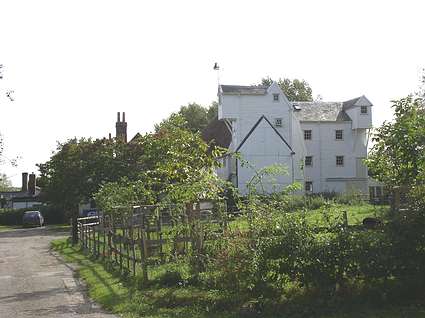
|
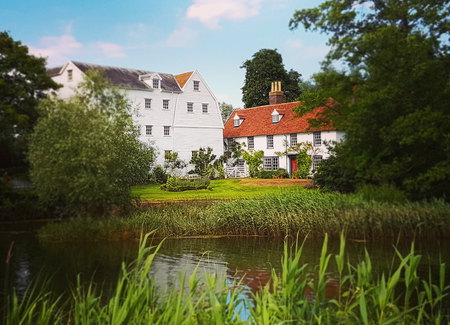
|
Rear
View with pond. Footbridge would be to the left of picture
Acknowledgment to Matthew Beales
|
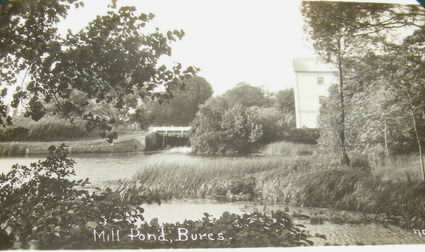
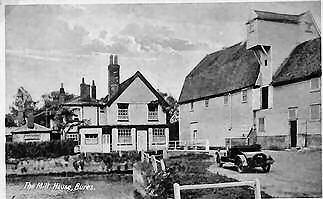
Dated 1922
Before the Weir below was installed, the white railings probably a foot
bridge
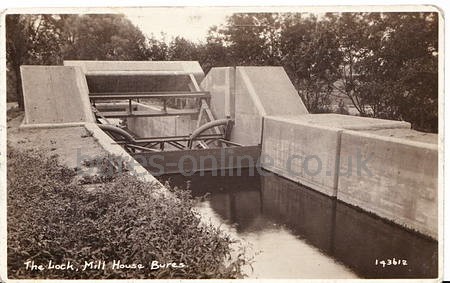
Postcard dated April 1939
|
In
1938 a major flood protection scheme was carried out at Bures with
an automatic lock built on the original lock site. This picture
taken in 2002 shows it to be of similar size to the old lock.
|
Brief history of Mill:-
The first recorded mill on or near this site at Bures has been dated at
1190.
The owner of the Bures Mill was recorded in the Domesday Book as a Saxon
landowner by the name of Witgar. It is remarkable that the last miller
at Bures Mill, Witgar Hitchcock, should have been named after Witgar the
Saxon mill owner.
A century after the Conquest in 1066, in the middle of the 12th century,
the Norman Sylvester family were responsible for building a new mill at
Bures
They began a large scale diversion of the river to the north, leaving
the old Anglo Saxon course of the river to the south. The course of the
river was shortened and taken more directly to the site of the new Mill.
In 1640 the timber framed
Mill House was erected and extended in 1820. Part of this structure can
still be seen today.
The river was opened to
navigation in 1715 which enabled barges to transport material to the mill
for grinding. Foreign wheat was used mainly for grinding into flour which
arrived by barge from Mistley.
Water in the early years was the only and obvious source of power to turn
the massive 16ft stone grinding wheels.
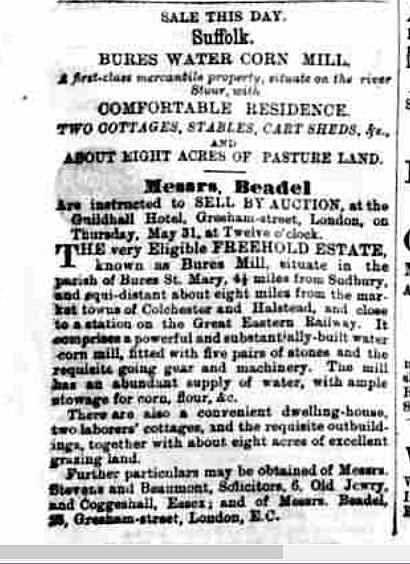
Suffolk and Essex Free Press May 31st 1866 |
 Essex
Herald May 31st 1866 Essex
Herald May 31st 1866
|
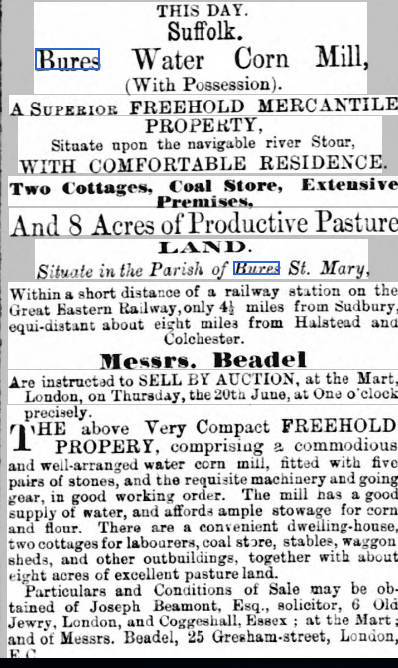
Essex and Suffolk Free Press, June 20th 1867 |
The Mill was still
being advertised "For Sale",
more than 12 months later in
June 1867
|
Cornelius Hitchcock purchased
the mill in 1875 and a further mill at Wormingford during 1879. His greatest
achievement was in 1893 when he changed over from stones to roller flour
milling at Bures. Instead of producing wholemeal flour on stones, the
new Hungarian system of roller flour milling produced the white flour
so eagerly demanded by the public.
Hitcocks had other mills at Rattlesdon and Fingringhoe.
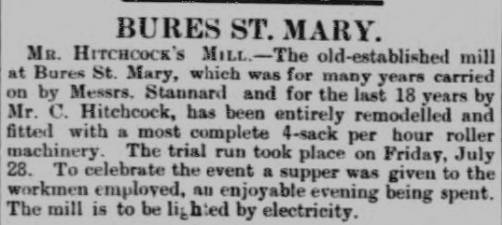 |
Essex County Standard,
West Suffolk Gazette and Eastern Counties Advertiser, August 5th 1893 |
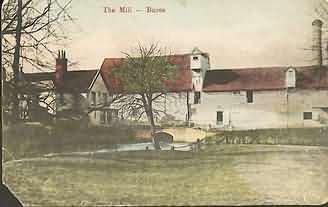
|
A
rare photograph of the mill, early 1900`s.
At that time, power was supplied by a steam engine, the chimney
clearly seen on the right.
The mill house is to the left. The loading ramp is above the mill
outfall
|
|
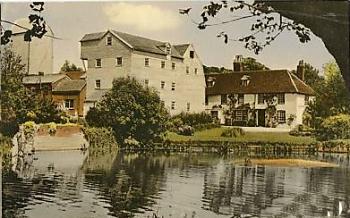
This
photo clearly shows the loading bay access.
Side elevation of the colour print above. (courtesy of John Ineson)
|
|
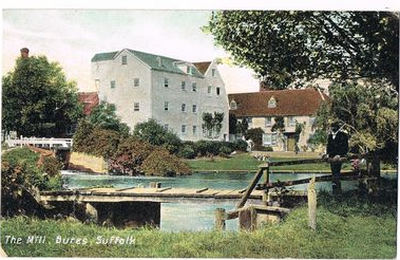
The
Mill circa 1961
The works to the left of the photo were demolished when the Mill
closed down
|
The river navigation
was closed in 1912 - the last barge to the Mill was during 1911.
 |
 |
|
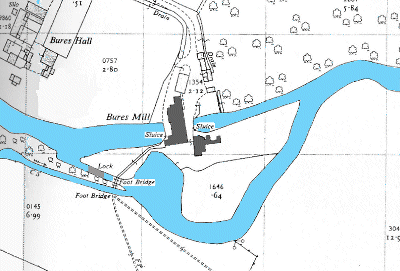
Map of the Mill
and Floodgates circa 1920
Courtesy of SCC
|
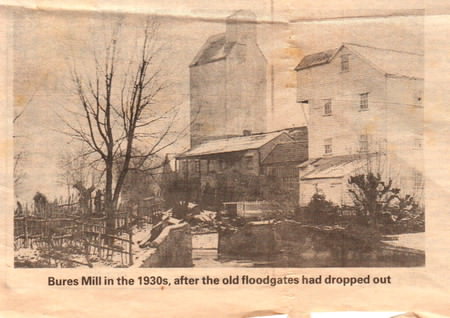
Damaged Flood Gates
which were never replaced circa 1930
|
updated 25/02/2017
update with Danaged Floodgates 22/01/23
|