|
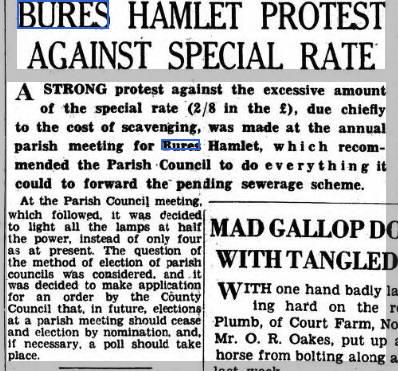
During the early 1930`s a Parish
Council Meeting discussed the possibility of bringing mains sewage
disposal to the village at a cost of
£3976. There was no means of raising this large amount of
money and nothing was achieved until two decades later, when the
financial outlay increased by ten fold to
£30k
During the late 1930`s and until
the mid 1950`s, the village waste such as Slaughterhouse effluent
and Human waste was collected by the "Night Soil"
man.
The term "Night Soil" was used as this task was
carried out late at night.
This basically consisted of a horse and cart which would transport
the effluent to a site just outside the village centre.
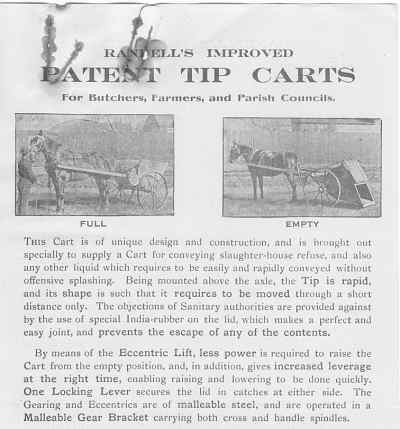
A Typical "Tip Cart" is
described here >>>
This task was not unique to Bures,
it would have been carried out throughout the country.
|
|
|
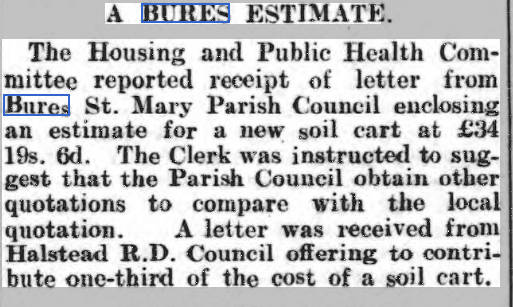
Free Press and Post,
January 8th 1938
|
|
Notes taken from Bures St Mary Parish
Council Records 1938.
Three tenders were received to deal with
the village waste.
| Name |
Fee for Bures Hamlet
|
Fee for Bures St
Mary
|
Total
|
| W Cardy, Grove Cottage,
Cuckoo Hill |
£84
|
£126
|
£210
|
| A Willingham, 6 Council
House, Nayland Rd |
£117
|
£78
|
£195
|
| Herbet Clark, Cuckoo Hill |
£118.50
|
£79
|
£197.5
|
Although the Parish Council dealt with
the local issue of contractor and equipment, Long Melford District Council
made the ultimate decisions.
Herbert (Bert) Clark was duly granted the contract as "village scavenger"
The contract for "Emptying Cesspits,
and pail closets, earth closets and house refuse collection"
was very lengthy and precise in its detail such as:-
(a)No excremental refuse to be in the streets
between 0800hrs and 2200hrs during April and September or between 0900hrs
and 2200hrs from October to March.
(b)The contractor is forbidden to ask for any fee or gratuity
(c) The contractor will be required to collect and dispose of the refuse
from the earth closets and pail closets once weekly.
(d)The contractor when requested by a householder will properly empty,
discharge and cart away all the excremental refuse contained within the
different receptacles
(e)If any waste was to be found on the highway or pavements the contractor
had a qtr ton of Chloride of Lime at hand. As we know today this was a
very toxic chemical to use, easily burning the skin.
Tenders were received from Brands of Bures,
Webbs of Long Melford, Ransomes of Ipswich and Joslins of Colchester to
supply a cart suitable for the transportation of wet material.
Brands of the High Street were very adamant, that as a local firm and
a large ratepayer they should be awarded the contract.
Letters indicate their great displeasure on hearing others had been asked
to tender for the cart.
|
Finally Long Melford DC granted the
contract to Webbs of Long Melford.
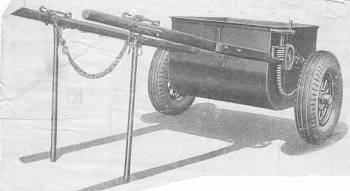
The tank had a capacity of 150 galls
made from 3/16th steel with rubber tyres. The tank was tipped by
turning the hand wheel. The lid to be totally sealed to avoid spillage
This news could not have been received
very favorably by "Brands" in the High Street. They had
been quite scathing about their competitors quality of build.
|
|
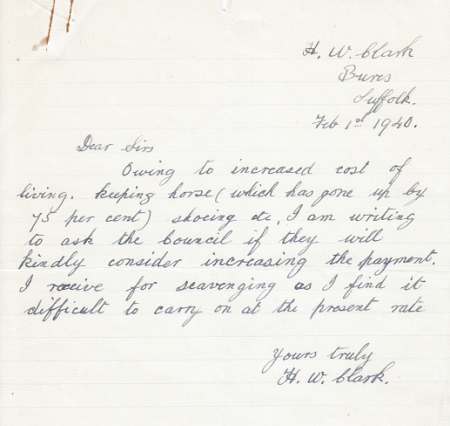
From records it
appeared Bert worked on a 2 year rolling contract.
Only two years
after gaining the contract, he wrote this letter to the Parish
Council seeking an increase.
The Parish Council
thought this was totally justifiable and awarded him £160
per annum just for Bures St Mary.
This included a fee of £32.12.3d which was the additional
fee for scavenging and the collection of house refuse due to the
increase in evacuees.
Before starting
work, Bert and his helper "Cardy" used to visit "The
Swan" for refreshments to see them through the night.
Another of Berts helpers was Albi Austin, so the job couldn't
have been that bad !
Parishioners were always complaining to the Parish Council about
excrement left on the pavements after these two passed by.
No doubt worse for wear with the
drink!
The local rhyme about Bert went
as follows:
Hark,
Hark, here comes Bert Clark
The dykeman has come to town
With his apron bag he collects his swag
and his favourite colour`s brown
|
|
|
|
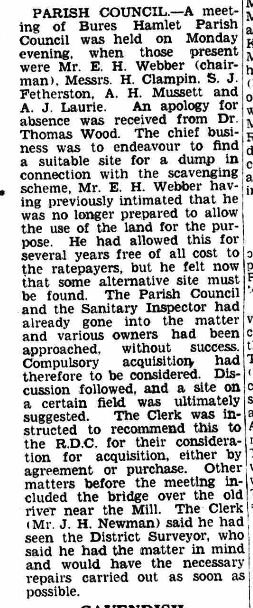
Parish Council meeting September
1943
Where to dispose of the Night Soil ?
Reported in the "Suffolk and Essex Free Press, 23rd September
1943"
The location was
described as "plot of land adjoining the Bures to Nayland
Rd at Clicket Hill. Access to field by single farm gate for night
soil deposit. The material would have been deposited in trenches
rather than just spread across the field.
This would have been the field on the right looking towards the
river, as you pass along the top of Clicket Hill.
Today's modern
sewage plant stands on the same field.
|
|
Suffolk Free Press,
March 25th 1948
|
|
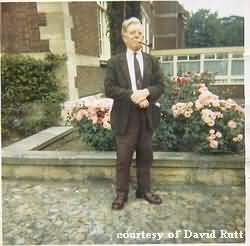
Bert Clarke lived
along Cuckoo Hill in the cottage half way up, we now know as "Cuckoos
Nest".
He generally helped out at Fysh House Farm and gardens during
the day.
Bert stabled the horse in the black barn along the track, between
the Farm and Clickett Hill.
It`s not known when Bert retired but it must have been late 40`s
or early 50`s.
Before the arrival of mains sewage, a Cambridge slurry firm used
to visit the village once a week with a tanker.
Mains sewage came to the village circa 1955/6
|
|
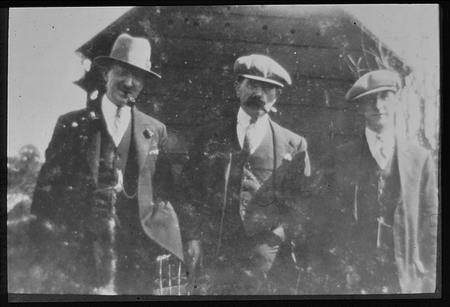
Chris Clarke, Bert Clark and Frank
Clark
(were they brothers ?)
|
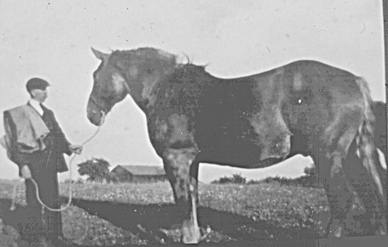 Bert with his trusty horse "Nelson"
|
GENERAL NOTES:-
Health
In all the time the Night Soil man was working (1938 to 1955) not one
single case of an infectious (reportable) disease was notified.
Does this back up the case whereas today our immune system is so weak,
we seem to get ill at the slightest contact with infection - ed.
Disposal of waste before the Night Soil
man.
Disposed of locally by the householder !
Thrown into the River !
-----------------------
B1508 Main Road
This road between Bures Hamlet and the Mount Bures turn off, was once
called Shytbourne or Shithorne Street.
During the late 1840`s and early 1950`s the Night Soil cart could often
be seen leaving Bures Hamlet along this road.
During this time the owner of Bures Hall ( or Mount Bures Hall) made a
profitable practice in collecting this residue to spread on his farm land
Ref Ida McMaster book
--------------------------------------------------------------------------------------------
Extract of School Documents
made by Mr Creek Headmaster circa 1933:-
At the far side of the playgrounds was
a long narrow building for the lavatories, one end for the girls and infants,
and the other for the boys. There were no facilities for washing hands
except in the main building. The boys urinals were unroofed. The row of
privies, each with its bench-seat, had a bucket beneath, which was emptied
from a passage at the back of the building once a week by the man with
a horse-drawn nightcart - there was no other sewage system in the village.
A similar scheme
to the one detailed above must have been in operation - ed
-------------------------------------------------------------------
Extract of letter from resident of Ropers
Cottages to the Chairman of the Parish Council, June 1947
Dear Sir
The Lavatory Pails in this group of cottages have not been attended to
for many months. Has this local service been suspended?
-----------------------------------------------------------------------------------------
1950 report of the local Medical Officer
of Health:
BURES ST. MARY
The sanitary system of Bures in the main consists of pail closets, a few
cesspools and open drains, none of which from a health point of view are
in any way acceptable.............................
-----------------------------------------------------------------------
Bures St Mary Parish Council.
There was also much correspondence in 1937-8 over tenders for a new
sanitary cart. At that time emptying of pail closets took place once a
week. (Cesspits were emptied as required, and house refuse collected once
a month) In the late evening, a carthorse dragged a metal tumbler cart,
with clanking buckets behind, stopping and starting, through the village.
At the school it would come into the boys' playground, empty the buckets
in the girls' and boys' privies, and then go to the far end of the playground,
where a little cupboard-like door at ground level was unlatched, and the
buckets from the school house outdoor· privy was emptied. One resident
who hated the eerie sound of the heavy horse and clanking buckets in the
quiet traffic-free evenings, was always afraid the cart would come to
empty the pail while she was out for a last visit to the lavatory before
bedtime.
------------------------------------------------------------------------------------------
Mains sewerage came to the village approx 1955, at an approx cost
of £30,000
This was at the time of the Suez
Crisis. Work installing the pipework was hindered somewhat, by the shortage
of petrol.
One incident recalled was a supply of 40gall barrels of petrol arriving
as an emergency supply for the machinery, diggers etc. These were stored
overnight in the Sewerage Station in Nayland Rd, which was under construction.
However, on opening up next morning, the barrels had mysteriously vanished!!
CLICK HERE for Mains Sewage information
Additional
Notes.
Apart from using Night Soil as a fertiliser for agriculture, it was
also used (urine) in the fulling of cloth.
Additional
text written by John manning in his book "My name is John"
In one of the cottages on
the left, known as 'Cuckoo's Nest' lived Herbert ('Bert') Clark, the
famous Night Soil Man known by many as 'Clarky'
In 1938 the Parish Council
records show his appointment as 'village scavenger' for a contractor
for 'emptying cesspits, pail and earth closets, and for house refuse
collection' at an annual charge of £118.50 for Bures Hamlet plus£79
for Bures St Mary. . . .a total for the whole village of £197.50.
I reckon that was a pretty 'foul' salary even in 1938 for that sort
of job! The terms stated that no excremental refuse was to be in the
streets between 0800 and 2200 hrs during the months of April and September
and between 0900 and 2200hrs from October to March...it seems he had
a free all hours hand for the summer months only from May to August!
He was supplied with a quarter of ton of Chloride of Lime to deal with
the consequences of spillage. . .a very toxic chemical prone to skin
burning.
No holes in your gloves Clarky if you wanted to keep your fingers! His
150 gallon horse pulled cart had two rubber tyres and a steel tank with
sealed lid which would be tipped by operating a hand wheel. The refuse
dump was a plot of land accessed by a single field
gate on the left situated about a mile and a half from the school on
Nayland Road.
The sewage was deposited in trenches rather than just spread across
the field. . .not a popular dog walk I would have thought!
The present modern works are situated on this same site.
Bert had a 2 year rolling contract and, following his request for a
revision because of an increase in the cost of living including the
feeding and maintenance of his horse, he was granted an extra £81.00
for Bures St Mary which included taking into account the influx of evacuees.
He would have retired by about 1950 and until the mains sewage came
in 1956 the service was then provided by Alf the service was as good
as old Berts?
I bet it cost a heck of
a lot more! During the day he did odd jobs at Fysh House Farm at the
top of Cuckoo Hill and stabled his horse in that big black barn along
the track at the top of the ClayPits The continuation of that track
led down to the sewage dump in the field next to what was known as Clickett
Hill on Nayland Road so you can see he had a very convenient location
to live and carry out his work. Bert had a helper 'Cardy' and they used
to fortify themselves for the night's work at the Swan and when complaints
were sometimes made to the Council about spillages there was a natural
suspicion that on occasions they were the worse for drink.
However, during this period not one case of reportable infectious diseases
was notified.
Before the Night Soil Man was appointed waste was 'disposed of locally
by the householder' ...guess you had to watch your step!
Information
supplied by:-
D & K Frost/David Rutt/Ezra/Philip Powell/David Cawdell
Thanks to Pat Creek for the miscellaneous papers kept by her father.
Updated 10/05/2016 with rhyme
updated 13/01/2017 with Press reporting Council Meeting
updated 23/02/2017 with Hamlet Newspapaer cutting
updated 25/02/2017 with Joseph hayward Press Cutting
|