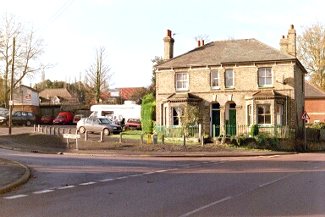
|
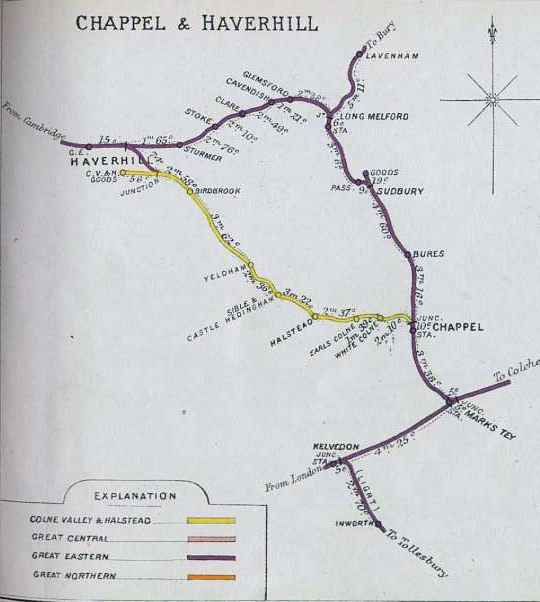
The present day rail
link runs from Marks Tey through Chappel to Bures and finally terminates
at Sudbury.
However, today it only exists as a small branch line compared to its
original route which ran from Marks Tey all the way to Bury St Edmunds
or Haverhill/Cambridge.
The line was opened
throughout from Marks Tey to Sudbury for traffic on 2nd July 1849.
The original train service consisted of four trains in each direction
on weekdays only. Fares were governed by an Act of Parliament, namely
3d per mile first class, 2d per mile second and 1p per mile, third
class. Third class remained in force until 1956, when it was renamed
second class.
The journey time between Marks Tey and Sudbury, varied between 28
and 45 minutes which was the average for such a branch line.
(Today by modern Sprinter the average
journey time is 19 minutes)
It was not until 9th
August 1865, that the link to Bury and Haverhill was finally completed.
The Branch Line
that never was:- Railways were gradually spreading over the region
and it was proposed by a small railway company in 1863 called the
Mistley, Thorpe and Walton Railway to run a River Stour Extension
line from the main line junction at Manningtree along the south bank
of the river through Dedham and Nayland to Bures where it would have
joined the existing Stour Valley line which runs from Sudbury to Marks
Tey.
|
|

|
Station
Layout circa 1900
|
Layout of rail
station showing sidings.
Today the `Paddocks` housing estate resides on the former goods
yard. |
|
|
|
|
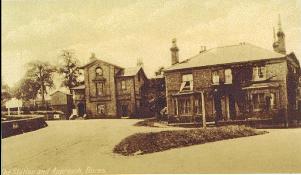
Railway
Station circa 1920
Three storey booking hall to the left.
Station
House:- Left was used by the Station Master.
The right side was the Police Station
|
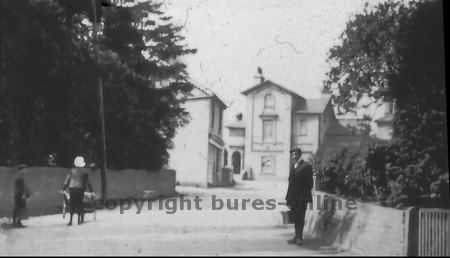 Bures Station circa 1900
 |
|
|
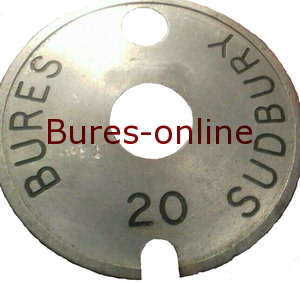
Track Token circa 1900,
used between Bures and Sudbury during single track working |
|
|
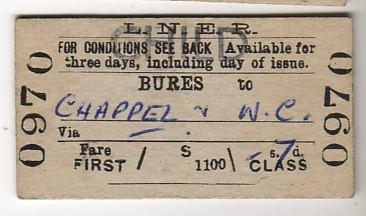
LNER Bures to Chappel
Child fare, First
Class
Date unknown |
|
|
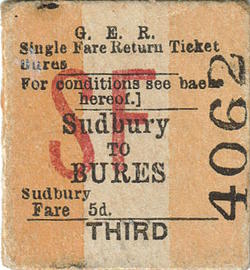
The return half of a
GER single fare return to Sudbury, date not clear but
probably around 1910.
(Ticket courtesy of Brian
Pask)
|
|
|
|
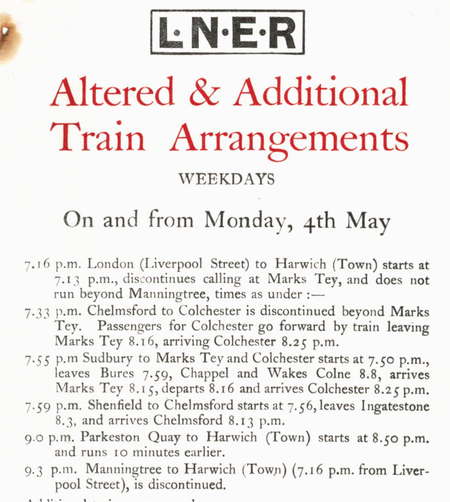
< 1925 extract from Timetable
1925 Timetable indicates travelling
time from Bures to Marks Tey = 17 minutes
2016 travelling time = 12 minutes
|
|
|
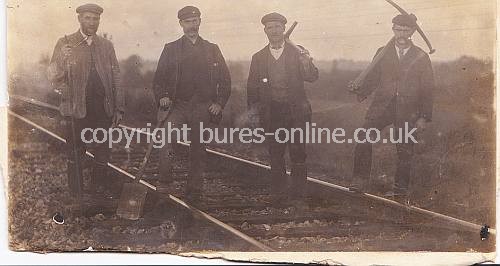
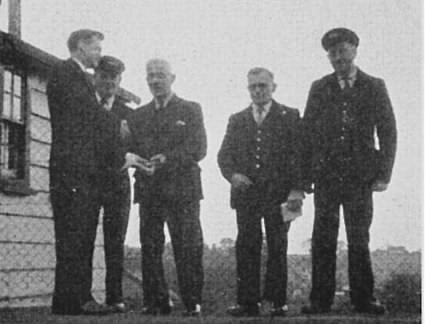
Railway workers at Bures
Precise date unknown, but may well have been circa 1920
Four members of staff, possibly with initials HD, FC, AB and
GC
AB would be Arthur Bitten.
HD :- Harry Diggins
FC:- F Cant
GC:- George Crick ( see below)
Image supplied by Guy & Caroline
Wisbey
|
|
George Crick
I believe that the "GC" in the photograph of the four
railway workers is very likely to be my grandfather George.
I drew the attention of my sister and a cousin to the item and
they are in agreement with me.
The evidence is as follows:
Our grandfather was a railway platelayer who, with his gang,
worked on the stretch of line between Sudbury and Bures. He
lived with his family of wife and four children at The Stocks,
Little Cornard. The Stocks consisted of two brick and flint
cottages and adjoining barn at the top of Stocks Hill.
These were demolished in the mid 1960's although the garden
wall is still there under the brambles and lilac and japonica
that were in the garden still flower every spring. Sadly none
of his grandchildren met him as he died aged fifty nine in 1938.
George and his wife, Alice Maud Crick, are buried in the churchyard
at Little Conard.
Rosemary Bullen, Sudbury
10/02/23
|
|
Samuel Francis
My Gt Grandfathe SAMUEL FRANCIS. worked as a Goods Porter for
G.E.R. at BURES at least between 1905 to 1911 and lived on High
Street. Prior to this, he had previously worked as a Goods Porter
for G.E.R. at FRAMLINGHAM STATION from at least 1891, living
at Railway Terrace. Also, Samuel may have attended to the signals.
There is a family story of him being an avid reader, and while
awaiting a train became so engrossed in his book, forgot to
attend the signals, which almost lost him his job and the house
they lived. which belonged to the G.E.R.
His wife's pleading I believe saved the day.
My grandfather Charles Phillip
FRANCIS would have been around the age of 12 at this time.
Courtesy of Sue Walker, Leicestershire.
Oct 2016
|
|
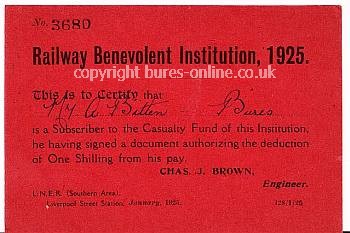
Image supplied
by Guy & Caroline Wisbey
|
The Railway Benevolent
Fund was set up to assist railway staff who fell on hard times
especially during ill health. |
|
|
|
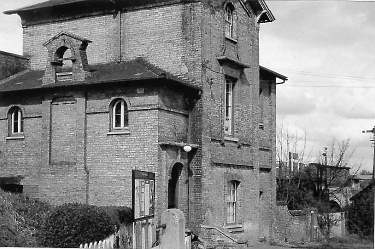
Bures
Station, Front
Entrance
|
Station Layout 1890`s
The passenger platform and station buildings were on the east
(village) side of the line. The main station building was
of three floors, partly because of the difference in levels
at the site.
On top was a belfry which housed the train arrival bell, this
could be heard across the village.
This can clearly be seen on the photograph to the left.
|
|
|
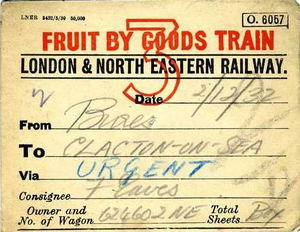
Wagon of fruit
sent to Clacton, presumably apples.
Fred Eaves had two large apple orchards in the village.
One along side
Colne Road and the other behind Friends Field.
Both now vacant land
Ticket dated 2nd December 1932
|
|
|
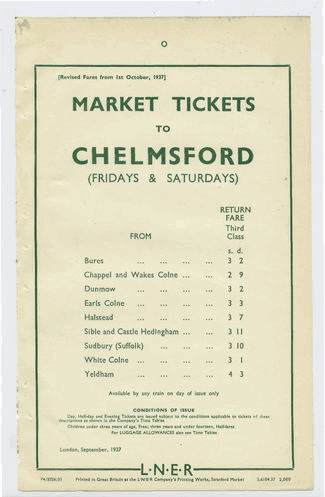
To attract more
rail users special discounted Market Tickets were introduced
to Chelmsford
during
1937.
|
|
|
|
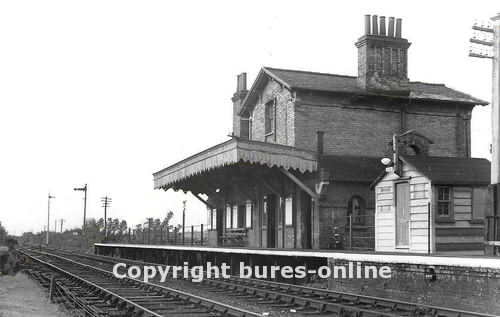
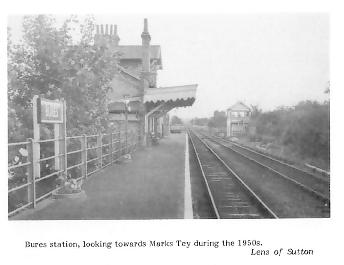
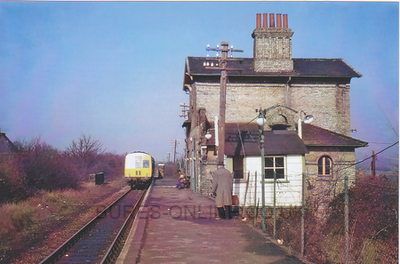
Bures
Station,
Platform View
|
Difficult to date this image,
but comparing it to other similar images it was taken before
1950
Thw wooden hut is still in use
today (2018) as a waiting room some 70 years later
|
 |
There
was a large Malthouse
on the west side of the line at the Sudbury end with Brickworks
beyond this. The signalbox was on the downside opposite the
Colchester end of the platform.
Cross & Garrods and Grimston & Co both had sidings at
the station, which could handle all classes of traffic except
furniture vans, carriages and portable engines.
To facilitate the unloading of wagons, a 1.5 ton crane on site
was on-site.
Circa 1960`s
Note:- The arrival bell hidden
behind the post
|
Chappel
Viaduct
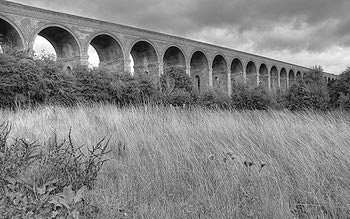
The greatest obstacle between Marks
Tey and Sudbury was crossing the Colne Valley at Chappel and the
Mount Bures ridge,
Construction work here began in 1847 at a cost of £32,000.
The original plan was to span the valley with a timber arch on brick
piers, but this was changed when workmen found brickearth on site.
With brick making material at hand, the design was changed in favour
of a brick arch.
Building this viaduct proved extremely difficult, to the extent,
gunpowder had to be used in places to move soil. The structure was
completed in 1849, some two years later.
It is 1066 feet long, with 32 arches of 30 ft span each at a height
of 75ft. The workforce consisted of 606 men with a team of 106 horses.
Some 7,000,000 bricks were used in its construction.
|
|
The chief engineer was Mr P Bruff
who later addressed the Institute of Civil Engineers.
Listening to this presentation was Isambard Kingdom Brunel,
the renowned Great Western Railway engineer. |
 |
The Viaduct still stands today
as a monument to Victorian engineering
July 2010
Photo courtesy of Game 1980
|
 |
Dated before 1914 |
Mount Bures Ridge
The
line from Chappel towards Bures traverses over 2 miles of deep cutting.
Once the Mount Bures summit is reached it then falls steeply away
with a 1:90 gradient towards Mount Bures crossing and finally into
Bures itself.
This proved to be major obstacle. There was little comfort or
shelter along this stretch of line, and the men desperately needed
sustenance whilst excavating the line. It was bleak to say the very
least.
After
a hard days work the workmen would walk to Bures to have a drink
at the local pubs. However, it was not so easy to return having
to climb the ridge back to Mount Bures after devouring many pints
of strong ale.
Consequently
the "Thatchers Arms" Public House was specifically opened
for the workmen. This immediately raised moral and provided refreshment
on-site with the added benefit of increasing the work rate.
The "Thatchers" still stands to this day and is in regular
use.
|
|
|
|
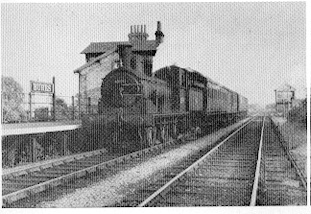
Bures
Station 1950 - Signal box can clearly be seen.
|
|
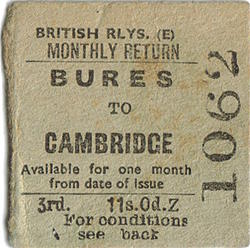
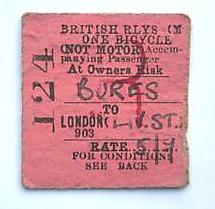
Outward half of an early
BR monthly return to Cambridge, dated 15th October 1951.
(Ticket courtesy of
Brian Pask)
|
The ticket is
an ex-London blank card (which could have been issued for
any journey from London) issued from agency 903 for a journey
from Liverpool Street to Bures and back. This is the return
half which would have been used for the journey from Bures
to Liverpool Street.
date circa 1954
(info
courtesy of Brian Pask)
|
Bures
Goods Traffic
Timber
One
villager can recall in the mid 1930`s, timber being hauled from
Assington, through the village to the railway sidings. This contract
lasted for at least 12 months. Typically, during 1938, 597 tons
of timber departed from Bures.
Farm
Produce
Butlers Farm during the second World
War used to transport Blackberries and Mushrooms to "Robertons
Wholesalers" at Covent Garden. Butlers used to employ local
villages to pick these wild on the farm, as they were so prolific.
Butlers in the 1930`s also sent "SheepFleeces" by rail
to Otterburn in Northumberland for processing into wool. They were
then returned as Skeins which were unrolled into smaller balls of
wool for knitting. (Busky Laurie)
Livestock
The main goods traffic was the transportation
of cattle. Back as far as 1913 on a Wednesday, an Express cattle
train would leave Colchester at 6.40am, destination Bury. This called
at Chappel, Bures and Cockfield attaching additional cattle trucks,
finally arriving at Bury in time for the morning market.
Cattle would often arrive back in Bures on the return journey, unloaded
and then driven through the village to their final destination,
the abattoir on Cuckoo Hill.
Various stations on
the line had cattle pens, allowing the transportation of livestock
to and from the Bury market.
This facility was axed during April 1961
The sidings can clearly be seen in the layout diagram above left.
"Cattle pen" is clearly marked at the sidings.
Outward goods traffic in 1938 amounted to 130 tons of meat.
Grain.
Grain destined for the Maltings opposite
and to a lesser extent the "Mill", were shipped through
the goods yard.
Outward goods traffic in 1938 amounted to
2,308
tons of grain.
|
Sugar Beet
This was transported by rail to Swaffham railway station then
onward to Holme Hale.
Holme Hale was a station on the Swaffham to Thetford Line
The wagon label show the sender to be the "Bures Farming
Compay Ltd"
Bures Farming Co is currently
being researched, the owners of this company remain a mystery.
Records at Companies House show it to be "Dissolved"
with no local name or address.
Why Holme Hale, this was
on the Theford to Swaffham line.
TO ABBEY:- this
may be a further clue, as there was an "Abbey and
West Dereham" station to the west of the Thetford
line feeding the Wissington Sugar Beet factory
This again is currently be researched
|
 |
Miscellaneous
Other goods to numerous
to mention would have passed through the goods
yard, such as newspapers, bricks, coal, milk etc.
|
|
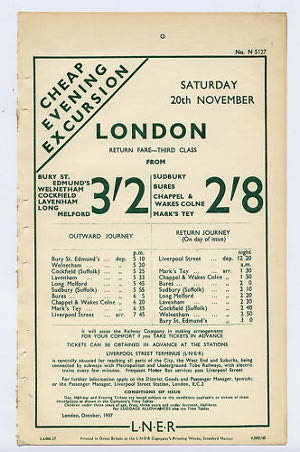
Excursion Sat 20th November
1937:
Rail ticket for a "Cheap evening excursion"
from Bury St Edmunds to Liverpool St.
This train arrived at Liverpool
St at 7.45pm, no idea what the latest train would have made
the return journey
|
Passenger traffic survey carried out
during 1955 found that the Stour Valley services clocked up 3270
miles during a single week, with a load factor of 17%, giving a
ratio of running costs to revenue of minus 415%.
1955 TRAIN EXCURSION
TO OLYMPIA:-
This was a new approach by BR to boost passenger travel.
300 people from Bures, Sudbury, Halstead, Lavenham and the Bury
area took advantage of excursions to Aladdin on Ice at the
Empire Station, Wembley.
 |
This ticket was
issued to travel between Birdbrook (Colne valley Line) and Olympia
This ticket is not predated, which suggests that there was a
series of trains rather than just one.
(Ticket courtesy of Brian Pask) |
Not only were seats assured on a
heated train but theatre reservations on behalf of the passengers
had been made and the train travelled direct to Wembley Hill station,
only two minutes from the theatre. Food was served on the train,
programs distributed and railway officials toured the compartments
making sure that passengers were conversant with all the arrangements.
A BR official said "We believe that this approach is paying
long term dividends"
|
|
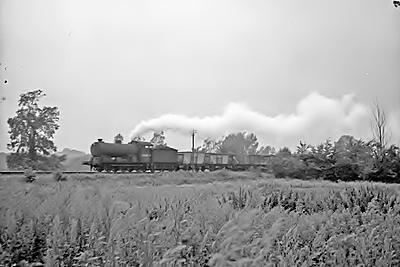
Steam locomotive transports
goods near Bures on August 16th, 1957 |
1958
 |
Kilverstone Hall
approaching Bures, November 1958 |
|
|
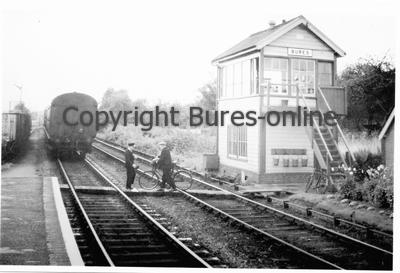
Signal Box 1958 |
|
|
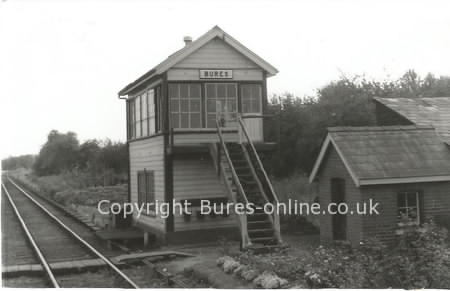
Signal Box 1958 |

Waggon und Maschinenbau (W&M)4-wheel
diesel railbus
Introduced by British Railways
in 1958 at a time when the railways were undergoing a transitional
period from steam to diesel & electric power, five German
built railbuses were procured.
This rolling stock travelled from Haverhill to Marks Tey
via Halstead or Sudbury
|

Currently at
the East Anglian Railway Museum
|
 |
On January
1st 1959 diesel multiple-units and diesel rail buses took
over from steam. This showed considerable cost benefit, but
it did not stem the steady decline of passengers from the
line.
This image shows a Derby Ligghtweight Trailer at Bures station
presumably sometime during the late 1950`s
Ref:_ https://en.wikipedia.org/wiki/British_Rail_Derby_Lightweight
There is no
records of this being used on the line on a regular basis,
so I can only conclude this may have been a trial run to see
the viability of a replacement DMU.
(Courtesy of Suffolk Free
Press)
|
|
|
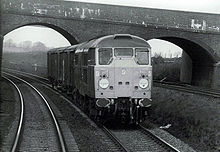
Brush Type 2 diesels (now Class 31`s) were often to be seen
on the Colne Valley section operating Clacton to Leicester
excursions.
At that time it was still possible to travel from Marks Tey
through to Cambridge or Bury
< Example
of Brush Type 2, not taken on this lone
|
.
 Albert Boreham, Signalman retires
after 38 years service
Albert Boreham, Signalman retires
after 38 years service
British Railways Eastern Region Staff Magazine, January 1959 |

New Station
Master arrives, 1960
|
|
|
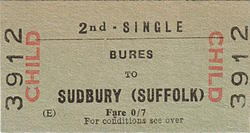
3912 is a BTC child single
to Sudbury, dated 8th April 1961.
(Ticket courtesy of Brian Pask)
|
|
|
 |
| Bures Station 1962 |
.
|
|
|
|
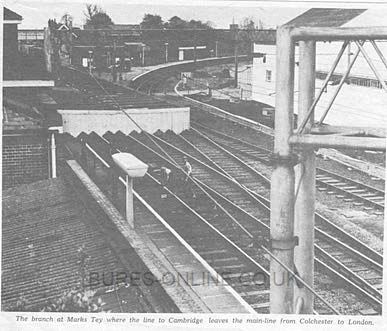
The Sudbury
branch line veers to the right at the
Marks Tey junction
1962
|
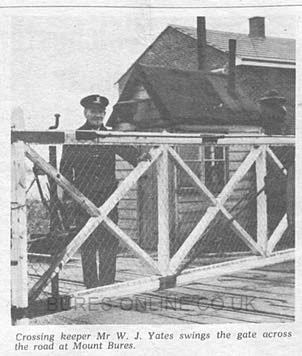
Mount Bures
Crossing with Mr Yates the Keeper
1962
|
|
|
|
|
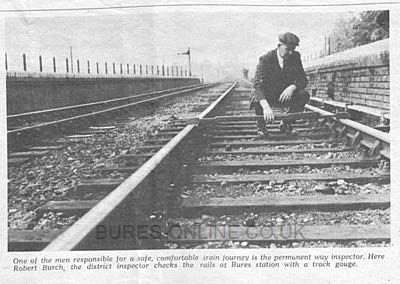
Track Inspection
at Bures with Robert Burch, 1962 - double track
|
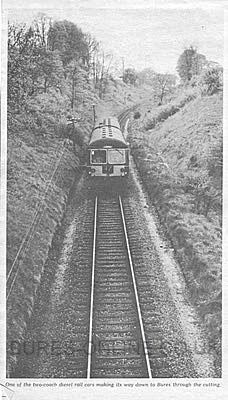
DMU along the
Mount Bures cut, dated 1962 -
This date must be incorrect, as it still still dual track in
that year
|
|
|
<<<<<<
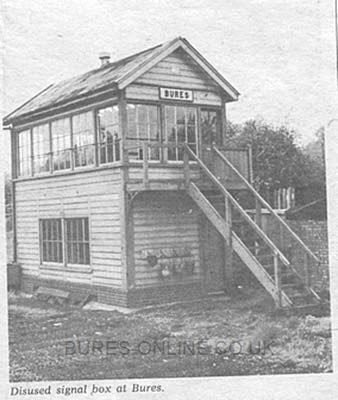
Disused Signal Box 1962 as it was no longer required for the Freight
Sidings
Demolished 6th Sept 1965 |
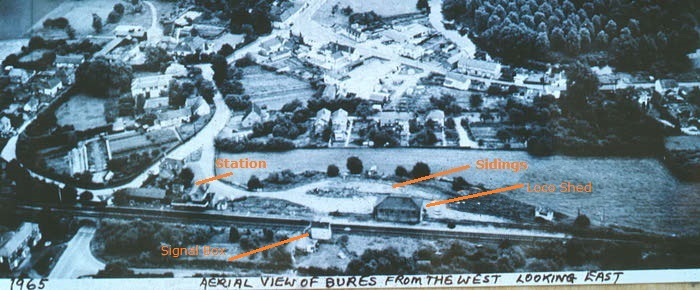 Aerial Photo taken 1965
The signal box still survives but the track sidings have been
removed. Today it is the site of "The Paddocks" housing
estate
|
|
|
|
|
The main rolling stock during the 1960s-80s were Diesel Railbuses,
Class 105 'Cravens' and Class 108 DMUs.
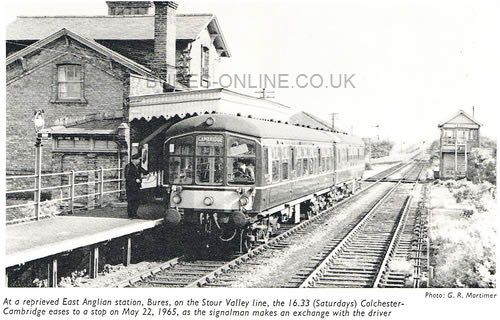
Double track
still in existance during 1965 >>>>>>>>>>>>>
|
|
|
Picture Right
>>>>
Taken 17th February 1973
DMU E56380 and E50378 arriving at 11.07am on the Sudbury to
Colchester service
Note, the Canopy was removed
in the early 1970`s
Compare with the image above.
Also now single track - one track
was removed between 1965 and 1967
|
|
|
|
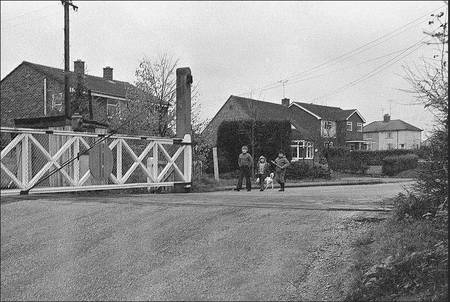
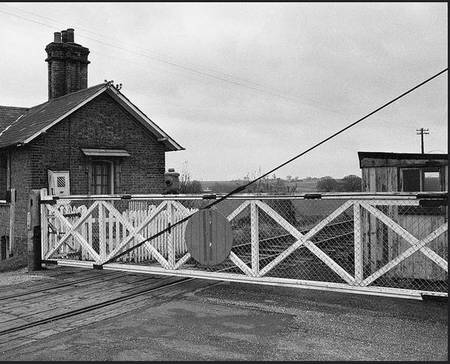 Mount Bures Crossing 1974, author
unknown
Mount Bures Crossing 1974, author
unknown |
|
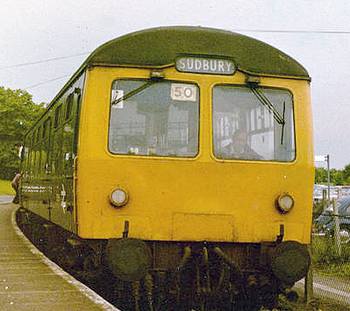
Shown here in April 1978, Bures station with a Cravens/Gloucester
hybrid DMU about to depart for Sudbury.
Courtesy
of Mark Dufton |
|
|
DMU Class 105 on route to Sudbury
dated 1979
|
|
During
the 1980`s and 90`s, Class 101 DMU`s were a common sight.
A press cutting
from 1983 " Passenger levels on all but the morning and evening
peak services are extremely low; the survival of this branch beyond
the 1980`s must be in the balance"
|
|
This
reduction in rail freight traffic is rather ironic as the arrival
of the trains had earlier caused the demise of barge traffic
on the river, carrying goods. Rail was now faster and more reliable.
The last freight train travelled on the Stour Valley Line on
18th June 1962.
The coming of road vehicles was now having the same effect and
the carriage of freight by rail, was ultimately doomed.
However, a single freight train was retained and ran between
Sudbury to Bures and back when required, but this ceased on
December 28th 1964.
The signal box at Bures was no longer required and was demolished
in 1965
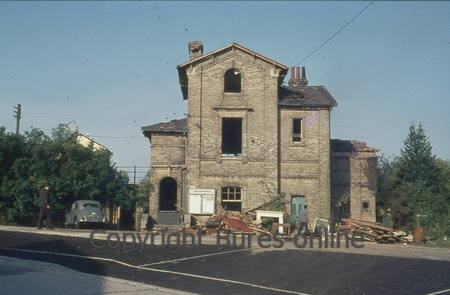
This photograph shows the demolition
of the station buildings in 1973
Photo by Olwen Titchmarsh, August 1983
|
updated
26/08/2014
Demolition of the station house
Technical
data taken from Branches & Byways of East Anglia by John Brodribb
updat with newspaper cutting 22/02/2017
updated with 1900 Station photo 29/08/21
updated 10/2/23 with George Crick info
|