| In 1921
there were two gasholders which provided the village until the early 1930`s
when the national electricity supply arrived. The Bures Gas & Coke Co
went into decline from that time, Two forms of gas were produced, both from
heating coal in ovens, but in one method, steam was passed across the coal
for greater efficiency. This was known as Mond gas.
In 1930 a Mr Brand of Bures was generating
electricity using a petrol engine and a dynamo to charge lead acid batteries
The power he produced was used to supply houses in the High Street, and
the Baptist Church.
Mr Deaves, who later took over the Gas Works in Bures was also producing
electricity at that time.
Mr Beard (see credits) recalls that Mr Deaves
batteries would last for some days on one single charge.
Sudbury had its own generating station. In 1920 the Old Granary building
fell into disuse as the river barges, which operated along the river Stour
from Sudbury to Mistley, ceased to be viable as the railways took over
as a means of transport.
The old East Anglian Supply Company acquired this building and in it came
one of the first public generating stations
The Old Granary was fitted with a thick concrete base on which an ex German
U-boat diesel engine was mounted and coupled to a dynamo. Why this engine
was transported from Harwich by road, and not by the river, is a mystery.
This combination was never actually used to provide a supply for the public,
as trouble soon came when the engine broke down and spares could not be
obtained.
It was perhaps appropriate that the replacement engine was from an American
Submarine Chaser. This worked satisfactorily and produced up to 150kW
of power. This engine, although originally diesel, was converted to run
on Producer Gas, and with a little help from a German Lanz Traction Engine,
was able to cope with the demand for some time.
The switchboard for this was mounted on a raised platform, which helped
to avoid the risk of flooding from the nearby river It was common practice
at that time to build switchboard at high level.
This was in 1923 when memories of the first world war were still vivid.
Which probably accounts for the time when a man from Norfolk was working
at the station, and having a strange accent, was mistaken for a German!
He was tormented to the point of having a brick thrown through the front
window of his house.
So successful was this new Station, and so confident was the Supply Company
that each new customer was offered three lamps and one power socket free
of charge when the supply was connected. This incentive was actually used
in other places at around that time.
Some of the larger houses, and some Factories in Sudbury were already
generating their own electricity
Examples of this were found in Melso's Knitting Mills and France's Corn
Merchants. These factories did actually sell some of their surplus electricity
to neighbouring properties. .
The generators in the Old Granary eventually became overloaded. This became
very apparent on a Saturday night when all the shops were open. The lights
began to flicker and the candles were again lit to provide the illumination
for the customers.
Fortunately, in 1927 a high voltage supply arrived in Sudbury under the
control of the East Anglian Supply Co. The point of supply was in Edgworth
Road at the rear of Brunton`s Propeller Factory (now demolished, adjacent
to Waitrose)
As the incoming supply was alternating current, rectifiers had to be installed
so that the supply could be converted to direct current and so be compatible
with the existing equipment
High voltage switching equipment was installed in this substation in Edgworth
Road.
In fact the same building exists today with more modern switchgear but
performing the same function
The Old Granary was no longer needed for generation and so became a Storeroom
for the Electricity Company.
It was sold to the Gas board in 1955 for £300.
Later, in 1963, The building was to be demolished, but it was bought by
Mr Harry Turner for conversion to an indoor cricket net.
Before it could be fitted out as a cricket net there was the small problem
of the
concrete base on which the generator stood. This defied many attempts
at removal After some Pneumatic Drills were damaged in the effort to break
the block. a total of 90 sticks of gelignite were detonated in order to
finally break the concrete .The walls of the building did not suffer from
this explosions.
This is perhaps not so surprising when you realise that they are 21 inches,
or over half a metre thick
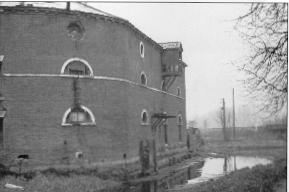
This massive building was constructed
in 1791 and it is a credit to it architects and builders that it stands
in such perfect splendour over 200 years later.
It is almost a monument to Michael Faraday himself as it was built in
the year that he was born.
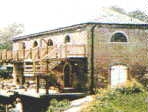
The building
on the left shows it during the early 1950`s. This old structure has been
transformed into the building we know today as "The Granary",
part of the Quay Theatre
During 1927 an 11000 volt overhead
line was built from Halstead to Sudbury and to Edgworth Road Substation.
This line was to replace the previously abandoned underground cable, as
by that time 11,000 volts was becoming the standard for rural electrification
and remains the standard today.
A retired EEB engineer, recalls how the line was actually taken through
a large tree which was in the route of the line. The insulator was then
fixed to the tree to support the wire and prevent accidental contact.
Such methods of construction, definitely not used these days"
When in 1927 the Company brought a supply to towns such as Sudbury, large
mercury - vapour rectifiers had to be installed so as to be able to supply
the existing Direct Current systems and so replace the dynamos. In some
places, alternating current motors were used to drive the original dynamos
to get back to DC.
As the DC supplies were gradually replaced
with alternating current the rectifiers and rotary convertors also became
obsolete.
In 1932 the construction of an 11000 volt
overhead line was completed from Sudbury along the riverside to Bures.
This line again is clearly visible, as with some reinforcement, it is
one of the lines bringing the supply here today. The fact that it crosses
the river so many times doesn`t make fault location and maintenance an
easy task.
After some two years of trying to raise
capital for the Company. known then as East Anglian Electricity Ltd, the
city finance houses failed to find the necessary money.
In 1925 the Company was restructured and
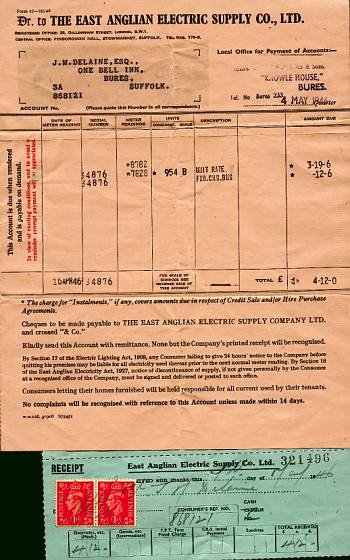
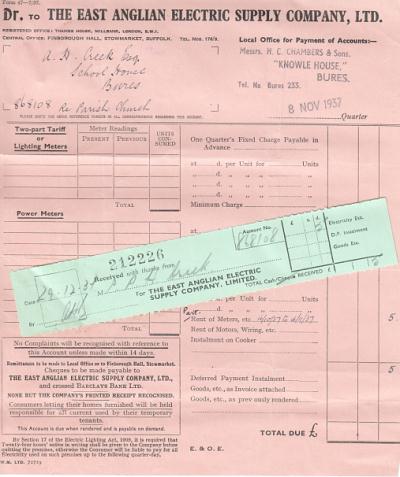
renamed "The East Anglian Electric Supply Company Limited" and
capital was still not forthcoming.
At this time some American businessmen visited this Country and showed
interest in financing the new Company.
However, hopes were dashed as they returned
to the States without investing any money at all.
Then in 1926 a second group of American financiers were introduced to
the Company. They were approached with some reluctance bearing in mind
the previous experience. This time they did indeed show great interest
and the much needed money was forthcoming"
It was this money together with new Act of Parliament, which enabled the
Company to provide supplies of electricity to the towns of Barrister,
Witham, Coggeshall, Kelveden, Halstead, Sudbury and a large number of
neighbouring villages- including Bures in 1932.
In about 1946 the 33,000 volt overhead
system was constructed and brought immediate reinforcement to the system
around Sudbury as it became overloaded.
There are of course the lines coming up
from the Colchester direction but in the early days there was no national
standard and local companies were free to build there own networks. Some
used different voltages, others different methods of phase transmission.
Even today this is evident, the 11kV system North and South of the river
has different phase relationships. This means that it is not possible
to connect the Essex system to Bures without the need to switch off the
supply from the Suffolk side first.
For this reason Eastern Electricity provided
an alternative supply from Suffolk - which actually comes from another
Primary Substation at Groton where supply is transformed from 33kV down
to 11kV.
The supply to Bures today is fed from Gt
Cornard via overhead lines through Henny and Lamarsh and from Groton near
Boxford as part of a ring main system. This means that the supply can
be taken from either way around the ring, in the event of a failure of
the one side.
Extract
of a talk given to the Bures History Society 1992.
Credit to the following who supplied
this information:-
Mr Beard of Colchester Rd (dec)
Mr Harry Turner of Sudbury.
Mr George Tilbrook previously of Corn Hall (Area Manager EEB, rtd)
© Mr Derek Beales of Tostock who gave the talk (Distribution Engineer
EEB, rtd)
|