 |
THOMAS WOOD, a composer
and author who was born on 28 November 1892 at Chorley, Lancashire,
the only child of Thomas Wood, master mariner, and his wife Hannah.
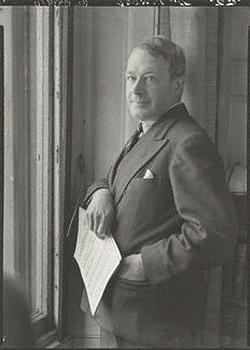
Left: One of many portraits of Thomas
hanging in the National Portrait Gallery.
|
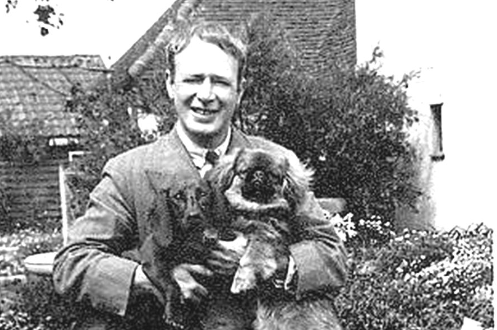 |
Despite congenitally poor vision due to
cataracts in both eyes, in 1913 he completed an external bachelor's degree
in Music through the University of Oxford.
In 1916 he joined Exeter College, Devon, but mid-way through WW1, the
Government were looking to conscript every male who could fight. Thomas
applied to join the Royal Navy, but he was rejected on seven occasions
as unfit due to his poor vision.
Undeterred, he joined the Department of the Admiralty in 1917.
After the war ended, Thomas in 1921 was appointed Director of Music at
Tonbridge School, Kent. Shortly afterwards Thomas returned to Exeter College,
where he was a lecturer in Music between 1924-27.
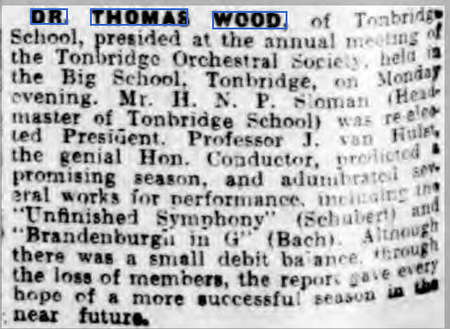 |
Both at Tonbridge and Exeter, he
won numerous awards and this prompted him to compose choral and
orchestral works.
During this period, he produced several compositions including Forty
Singing Seamen (1925), Master Mariners (1927) and The Ballad of
Hampstead Heath (1927).In 1930 he travelled to Australia, to conduct
Examinations for the Associated Board of the Royal School of Music.
Whilst there, he took advantage of his stay to travel and see as
much of Australia that was possible.
On his return to England in May 1936, Thomas joined the British
Ministry of Information and in the same year he published a modest
autobiography titled "True Thomas.",
|
As a member of the Ministry, this enabled
him to travel extensively overseas, including a visit to Canada in 1937.
The time spent on sea voyages gave him time to write the book "Cobbers
Campaigning" (London, 1940), a tribute to Australia's part in World
War I.
The 2010 edition of "Who's Who"
has Thomas listed as:-
Travelling extensively in Canada, including the North West Territories
in 1937; Commanding Officer Bures Home Guard in 1940; Principal War Work
in England, 1939-44 and radio broadcasting.
Sponsored by the British Government, in 1944, he returned to Australia
to give a series of popular talks and broadcasts about wartime Britain.
He then continued to visit the British Troops during 1944-45 in New Guinea
and Burma.
Member since 1921 (Chairman. 1946-48) Royal Philharmonic Soc.; Member
of BBC Central Music Advisory Cttee, 1947-50; Liveryman Worshipful Company
of Musicians, 1947; FRGS
Left: 1946 Newspaper report of Thomas becoming
Chairman of the Committee which Governs the Royal Philharmonic Society.
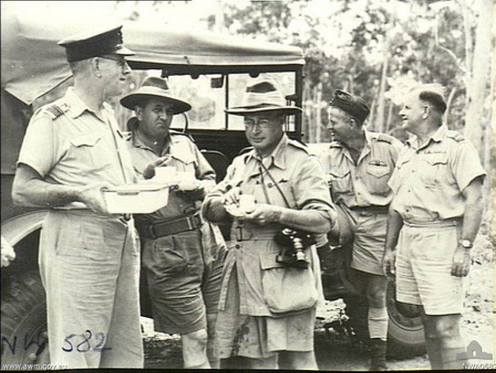 |
Left: Thomas (middle)
visiting the ANZAC troops in Burma and New Guinee. |
Thomas never forgot his roots back in Bures,
in 1940 he gave a talk on the radio for a BBC series called:-
"IN ENGLAND NOW".
This particular episode was called "My Village"
It started:
Thomas was a well-known composer, known
worldwide as the man who arranged the music to the Aussies National Anthem
- Waltzing Matilda, which he wrote during 1941.
Thomas arranged it from a text version given to him by the publican of
the North Gregory Hotel in Queensland during the 1930`s.
He also wrote a woodwind quintet entitled
"The Brew House at Bures". The Brewhouse was a seventeenth century
wing of Parsonage Hall where Thomas frequently sat enjoying the tranquillity
in front of a blazing fire.
Thomas, even today is still held in high esteem in Australia. If you look
at the Australian archived newspapers, you will find hundreds of articles
all featuring Thomas. With reports and photographs of him meeting the
Anzac troops in Northern Australia, New Guinee and Burma.
Survived by his wife, Thomas died of coronary
thrombosis on:
19 November 1950, aged 62, at Parsonage Hall, his body was cremated with
his ashes spread around his family home.
His estate was sworn for probate at £118,868.
ST OSYTH MAHALA EUSTACE
SMITH was born in 1886 in Hampstead, London.
She was the daughter of Thomas Eustace Smith and Katherine St Osyth Howard.
Her father, Thomas was a JP and Barrister, with offices located in North
Hill in Colchester.
Katherine's mother was called Mahala Howard and born in St. Osyth in 1826,
these names were then passed down to her daughter.
St Osyth was a pupil at the "Roedean School for Girls" in Brighton,
from the Summer Term 1900 to the end of the Michaelmas Term 1902. She
must have made a great impression, as she later became a Governess at
the School.
By 1912, the family lived in Wormingford
Grange, where St Osyth was very active in local community work before
and after her marriage. The same year when she was only 26 years old,
she became Secretary of the "Colchester Branch of Suffragettes"
The London Gazette
On June 7th June 1918, it reported Miss St Osyth Mahala Eustace-Smith
receiving an OBE for her work as "Hon Secretary, Essex Local War
Pensions Committee" at the young age of just 32yrs.
London Gazette
On July 24th 1924, at Wormingford Parish Church, Miss M. St Osyth Mahala
Smith, OBE aged 38, the daughter of
Mr T. Eustace Smith and Mrs Smith of Wormingford Grove was married to
Thomas Wood MA. D.Mus, son of the late Captain Wood and Mrs Wood of Barrow-on-Furness.
Only near relatives were present at the wedding.
The bride was given away by her father.
|
|
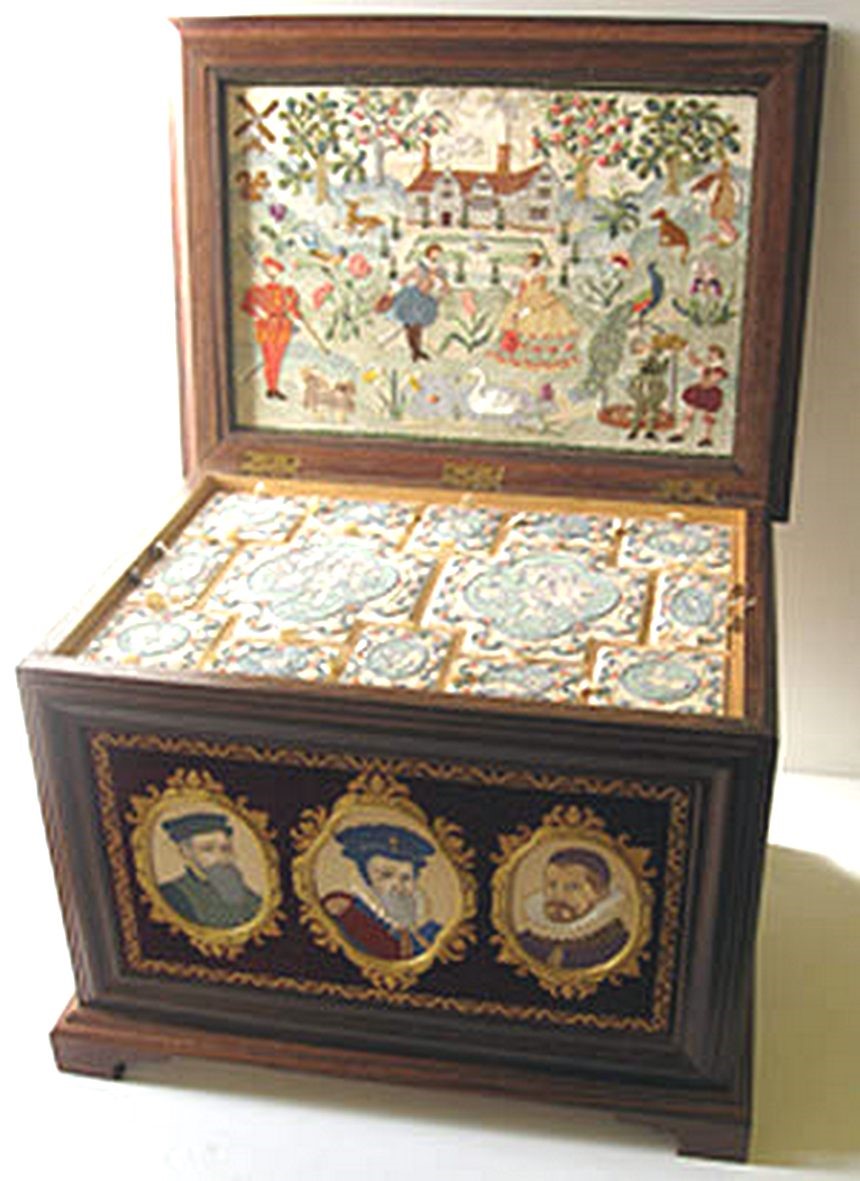
St Osyth`s
embroidery skills were outstanding and where necessary she manufactured
the wooden boxes and frames using her own woodworking tools.
In 1952, St Osyth was invited to take tea with Queen Mary at Sandringham
and bring along a selection of her embroidery work.
She took along a delicately embroidered box, on the lid was a picture
of Queen Elizabeth 2nd.
Queen Marys Secretary later wrote to St Osyth, saying the Queen would
like her to embroider Elizabeth, this time large enough to hang on
the wall.
St Osyth soon supplied Queen Mary`s with her request and consequently
received by return a letter of thanks this time from Queen Elizabeths,
Secretary.
St. Osyth had stated in her "Will" that her workbox and
needlework should be passed on to the Embroiderers Guild. These are
now deposited in their archives at Hampton Court Palace. |
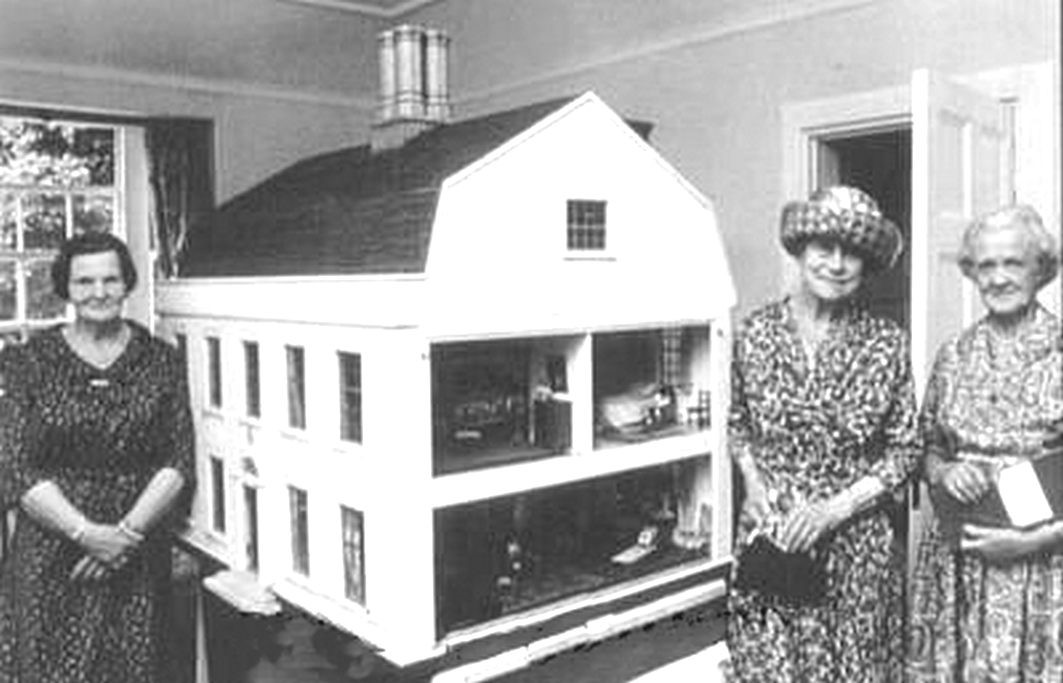
Mrs Wood was an accomplished carpenter and model maker. In 1955 Lady Whitmore
proposed to the Committee of the Essex Handicrafts Association that a
typical Old Essex House should be built-in miniature and furnished to
scale by members of the Association. It was decided to duplicate Boreham
Manor, home of Lady Ritchie.
The one person who did more towards furnishing
the house was St Osyth. Now In her seventies, she began wood carving and
making all of the tools necessary as none were available commercially
and small enough for the delicate work. With these precision tools, she
produced beautiful pieces of furniture to scale, many of them copies of
genuine antiques.
Nearly all the furniture in the house is an example of her craft, which
includes a dressing table in the main bedroom with a secret drawer containing
a Will. The staircase is a replica of Valley House at Dedham and the four-poster
bed in the main bedroom is said to be a copy of a local family bed.
 |
Mr Martin Evans of Feering, an architect
was approached to draw up plans. The house has tall Tudor chimneys
and an elegant Georgian facade, while the back is Elizabethan. The
rooms consist of a drawing-room, dining room, kitchen, nursery,
a Chinese room, main bedroom, gentleman`s room and bathroom.
The scale of the miniature house was to be 1inch to 1 foot and this
scale also applies furniture and fittings.
Mr Stiff was the builder and when it was completed, the cost for
the house's shell was £45 - then the members of the Association
carried out the plastering and painting.
In 1998 the Handicraft Association
decided to donate the house to Braintree Museum, where it would
go on public display for everyone to view.
The completed house at Parsonage
Hall, with Mrs Wood to the left.
|
In 2010, I visited the Museum to view this enormous piece of work. The
Curator gave me an extensive talk on how they acquired this exhibit, but
it appeared she had no idea of St Osyth`s background apart from the fact
she lived in Bures. On returning home, I sent her my research work on
both St Osyth and Thomas, which now forms an additional part of the exhibit.
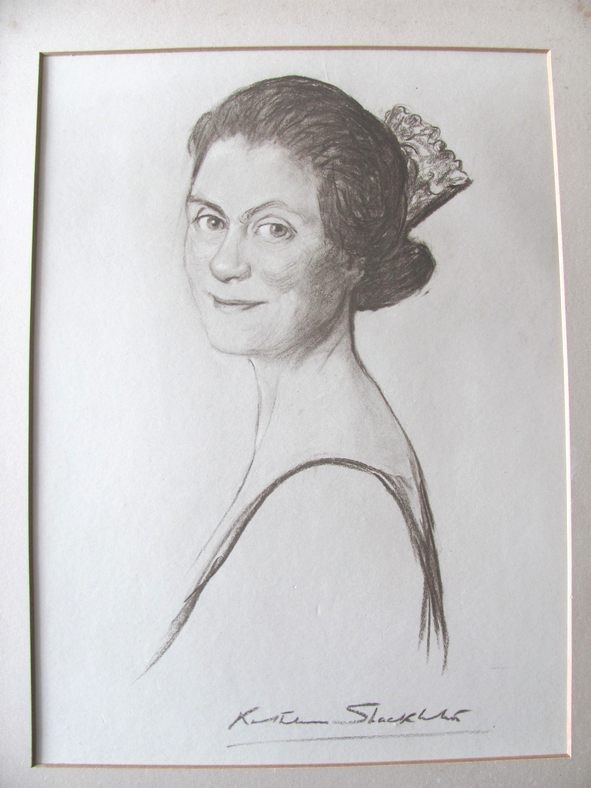 |
This charcoal portrait of St. Osyth
was drawn by Kathleen Shackleton.
She was the sister of the Explorer, Sir Ernest Shackleton and a
successful portrait artist in England and Canada.
The sitting was in Wormingford Grove, during 1921, where St Osyth
lived with her parents before they relocated to London.
This portrait originally was displayed
in Parsonage Hall.
When St Osyth decided to leave and move to Oxford in 1966, she donated
this portrait to Alfred Hume, her devoted handyman and gardener.
This is currently with Alfred's daughter, who now lives in the Midlands.
|
The London Gazette and The Times reported her death on Nov 1st 1970, residing
at Wasperton, Warwick.
She would have been 84 years of age. Her ashes like her husband Thomas,
were interned at Parsonage Hall.
According to records, St Osyth left a personal estate of £799,000.
THOMAS & ST OSYTH`s CONTRIBUTIONS
TO THE VILLAGE
Thomas was noted for his poor eyesight by the local residents, but few
cannot have known the full facts.
He was born with congenital cataracts in both eyes. His right eye was
near-blind except that he could only see flashes of colours and distinguish
light from dark, with his left eye and the aid of a powerful magnifying
lens, this provided him about one-tenth of normal vision. In the early
1900`s, doctors could offer him no treatment whatsoever. However, none
of this deterred him from his devotion to Bures and the generous help
he and St Osyth gave the community.
Commanding Officer of the Home Guard.
When the LDV/Home Guard was inaugurated, Thomas took the post of Commanding
Officer. During his time in office and his poor eyesight, he would get
his Adjutant, Richard Probert to read the Standing Orders and Correspondence
from the HQ at Halstead.
An Adjutant is an official military appointment given to an officer who
assists the Commanding Officer with unit administration; consequently
every piece of correspondence was passed to Richard to read.
This reminds me so much of Captain Mannering and Sergeant Wilson in Dads
Army.
Fire Trailer: Thomas and St Osyth
presented the village with a petrol driven water pump, which was a much-needed
addition to the old fire engine/pump used during WWII. (see Chapter 12)
Bures Scouts. St Osyth financially
supported the local Scouts on camping trips abroad, such as one visit
to Switzerland.
Church Bells. Just before his death,
Thomas promised a subscription of £100 towards the addition of two
bells to complete the octave in the church tower. He had undertaken to
guarantee the total cost of the work of £500, so that the project
might begin immediately. The target was to have the eight bells ringing
in time for the Festival of Britain celebrations in 1951. This inaugural
date was proudly achieved.
Vicarage Meadow/Field. Thomas and
St Osyth were instrumental during the mid-1940`s in purchasing additional
land from Col Probert, to extend the Recreation Ground.
This extension would make a combined sports field of some 5.5 acres.
The purchase of the land was still on the Agenda of the Parish Council
during 1945, so it must have been sometime after that date.
The portion of land known as Vicarage Field is now the site of the Bures
Cricket Pitch.
 |
Community Centre:- In the
mid-to-late 1950`s, St Osyth made a small donation to the Parish
Council, to launch a fundraising scheme for a new building to replace
the dilapidated wooden Victory Hall.
The initial fundraising achieved very little response from the parishioners,
as the village decided it was the responsibility of the Parish Council
to finance.
However, short of cash, the Parish Council opted for an inferior
wooden structure at £3,000.
St Osyth was not impressed with this suggestion and put forward
the argument for a modern brick structure. However, the cost of
this would be in the region of £10,500, which would include
all the fittings. The Parish Council were not prepared to finance
this more costly venture.
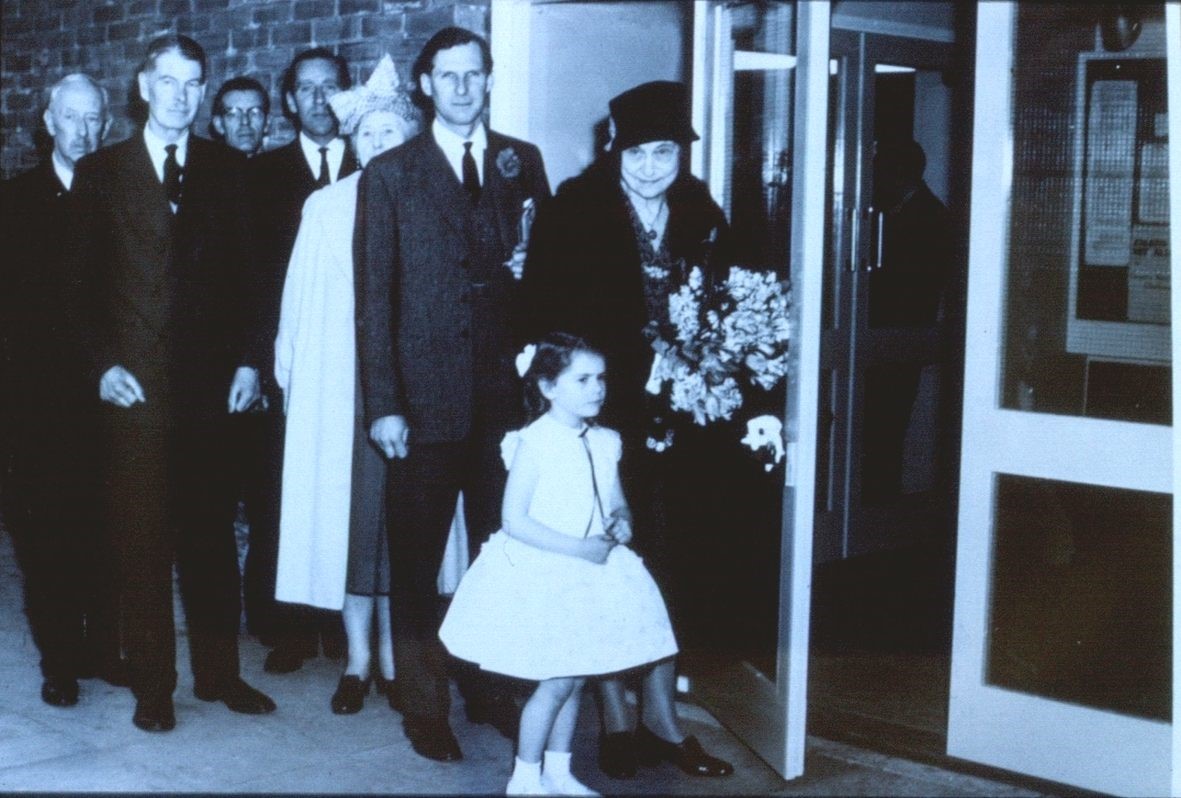
Left: Mrs Wood opening the Hall in 1961.
With no more ado, St Osyth donated £7,000 towards the cost,
with the remainder coming from the Ministry of Education.
So, the Parish Council didn`t play any part in financing the new
Village Hall (Community Centre), it was funded entirely by these
two single donations.
|
During the 1953 Coronation Celebrations,
the Sports Field was then renamed as the "St Osyth Playing Fields".
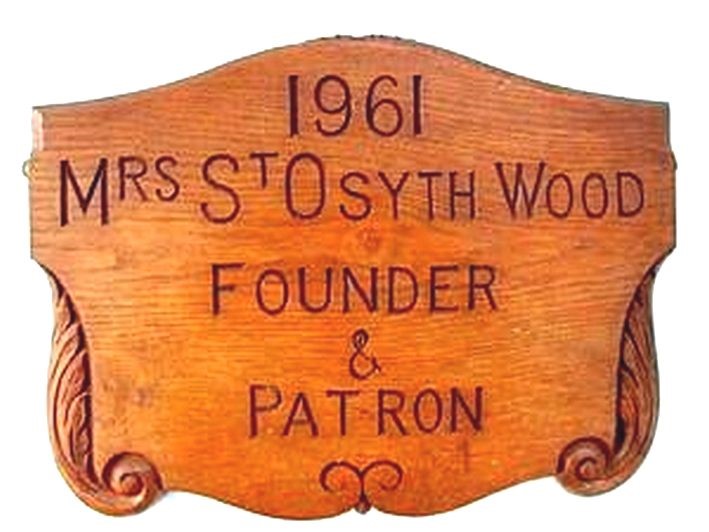 |
In the Foyer of the Community Centre,
you will see a wooden plaque commemorating St Osyth and her gift
to the community.
Visitors may not be aware of the
name, but it should be remembered if it wasn't for St Osyth, the
Community Centre would not have been the brick structure we see
today.
|
On the 4th November 1961, the Victory Hall
was placed in the hands of Percival's, Auctioneers for disposal with all
fitments. It failed to reach a reserve bid of £200 and withdrawn
from Sale.
It was then offered For Sale in the village by private negotiation, but
there was not a single offer.
John Ineson from Highfields Farm who was heavily involved with the Scouting
movement, purchased some of the fitments for the Sudbury Scouts.
Arthur Beaumont remembers his father dismantling the structure and taking
it away on a lorry, its final destination was a large bonfire.
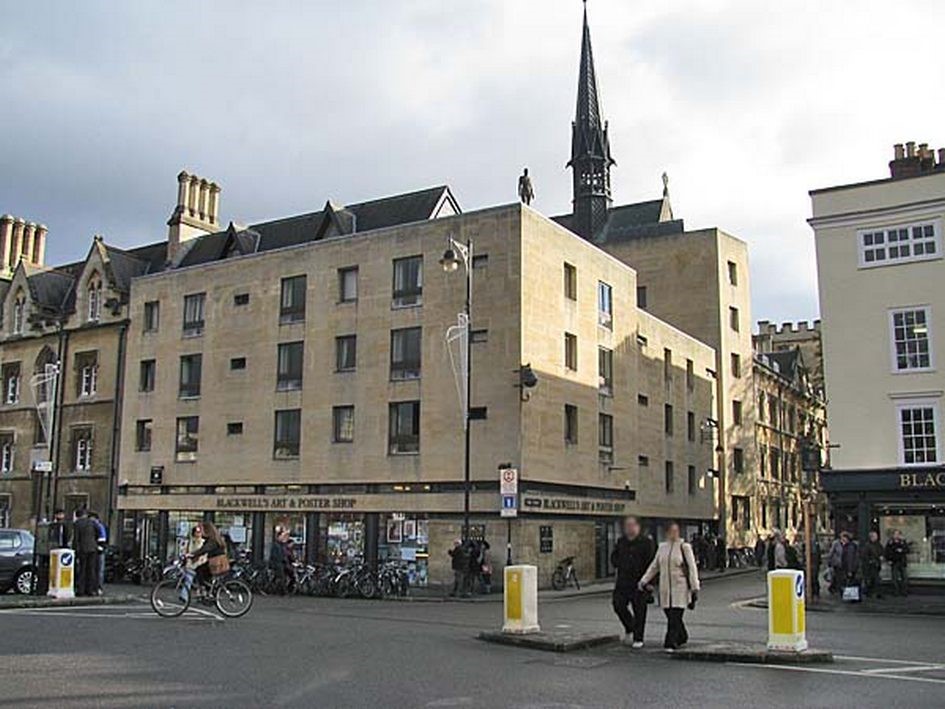 |
The Thomas Wood Building
in Oxford was constructed for Exeter College to provide student accommodation.
It was opened in 1964, to commemorate the 650th Anniversary of the
college and named after Thomas who taught at Exeter during the 1920`s
St Osyth was the main benefactor to this building, which still stands
today in the centre of Oxford.
I wonder how many people in the City, know the true story of Thomas
and St Osyth? |
There are numerous stories about St Osyth,
that I have documented over the years, this is one such tale:
During 1962/3, a local resident decided to build a very modern property
at Mount Bures based on a design from the Ideal Home Exhibition. The lounge
and kitchen being upstairs with a balcony to make full use of the panoramic
views across the valley.
When the owner arrived at the building site one day to check on the progress,
she was bemused to see a chauffeur-driven car standing on the drive and
St Osyth was making herself at home on the site. The owner was informed
by
St Osyth wearing a formidable flowery hat, "this modern type of house
was a blot on the landscape which could be seen from Parsonage Hall. It
was a disgrace!"
She was very polite, but she soon made her views known about modern construction
techniques.
I have devoted a complete website detailing
the biography of both Thomas and St Osyth.
When this was published several years ago, I was contacted by friends
of both of them, who provided me with a wealth of new information, which
I added to my research material.
.
|